Why Grade Selection Decides the Life of Your Wear Part
Two tungsten carbide wear parts with identical dimensions can differ in service life by a factor of ten. The difference is almost never the geometry — it is the calificación: the combination of tungsten carbide grain size and cobalt (or nickel) binder content chosen for the working conditions. Yet grade selection is one of the most misunderstood steps in buying carbide components, because suppliers often quote “tungsten carbide” as if it were a single material.
It is not. A 6% cobalt sub-micron grade and a 15% cobalt coarse-grain grade share the same name, but they behave like different materials. One will chip under impact loads that the other shrugs off; the other will wear rapidly in the abrasive environment where the first thrives. This guide explains the metallurgy behind that trade-off in plain language, gives you a practical selection framework, and shows where common mistakes happen — whether you buy piezas de desgaste de carburo de tungsteno for crushers, saw tips for wood processing, or precision components made from blocks and rods.
1. The Two Levers: Grain Size and Binder Content
Every cemented carbide grade is defined primarily by two variables. Understanding how they interact is 80% of grade selection.
Grain size: hardness vs. toughness
Tungsten carbide grains in a sintered part typically range from about 0.2 µm (ultra-fine, sometimes called nano or sub-micron) to 3–5 µm (coarse) and beyond. The general rule:
- Fine and ultra-fine grains (0.2–1.0 µm) give high hardness, high compressive strength, and an extremely sharp, wear-resistant edge. The trade-off is lower toughness — fine-grain parts are more likely to chip under heavy impact.
- Coarse grains (2.5–5 µm and above) increase toughness and thermal fatigue resistance, making them the choice for impact tools. The trade-off is lower hardness and faster abrasive wear.
A useful mental model: abrasive wear attacks the surface grain by grain, so small hard grains resist it best. Impact damage propagates through micro-cracks, and large grains with thick binder layers interrupt and absorb those cracks.
Binder content: the shock absorber
Cobalt binder acts as the metallic “glue” between carbide grains. Typical contents run from 3% to 25% by weight:
- 3–8% Co: high hardness and compressive strength, best for finishing, erosion and pure abrasion — cutting tools, nozzles, precision dies.
- 9–12% Co: the balanced middle ground, the most widely specified range for general wear parts.
- 13–20% Co: high transverse rupture strength (TRS) and impact resistance for crushing, stamping and heavy forming.
- 20%+ Co: specialty shock grades for cold heading dies and heavy forming tools.
Increasing cobalt always lowers hardness slightly but raises toughness — up to a point. Beyond roughly 20% Co the hardness drop accelerates while toughness gains flatten, which is why “just add more cobalt” is not a strategy.
2. Match the Grade to the Wear Mechanism
Before choosing numbers, identify how your part actually fails. Wear parts die in one of four ways, and each points to a different grade family:
Abrasive wear (two- and three-body)
Sand, ore, minerals, and hard particles sliding or rolling over the surface. This is the dominant mechanism in carbide jaw plates, liners, and ground-engaging components. Choose fine-to-medium grain with 8–12% Co, prioritizing hardness (HRA 89–92). Where the abrasive is very hard (quartz, corundum) and the load is light, drop toward 6–8% Co and finer grain.
Impact and shock
Repeated heavy blows — crusher teeth hitting uncrushable tramp metal, road milling picks striking rebar, press tooling closing on misfed stock. The grade must absorb crack energy: coarser grain (2.5–5 µm) with 12–16% Co. In extreme cases such as cold heading punches, 20–25% Co shock grades are standard. Sacrificing a few points of hardness here is far cheaper than a broken tooth shutting down a crusher.
Erosion (slurry, waterjet, gas-borne particles)
High-velocity particles in a fluid or gas stream. Erosion combines abrasion with localized stress, and corrosion may accompany it. For abrasive waterjet and slurry service, fine grain with low binder (3–8% Co) or even binderless grades perform best; binder-less WC and 0.3–0.6 µm nano grades exist precisely because the binder phase is the first to be scoured away. Our waterjet nozzles, for example, use a nano-grade with about 0.3–0.4% cobalt to reach 80–140 hours of precision-cutting life.
Adhesive wear and galling (metal-to-metal)
When carbide slides against softer metal under pressure — drawing dies, rolls, forming tools — the counter-material welds to the surface and tears away. Higher cobalt actually helps here because it resists micro-cracking of the surface, and surface finish matters as much as grade: a diamond-polished 10% Co grade will outlast a ground 6% Co grade in wire drawing. Drawing die nibs y rollos de carburo are typical applications where this combination of grade and finish decides groove life.
3. A Practical Selection Framework
Use this sequence when specifying a wear part. It takes five minutes and prevents most specification errors:
Step 1 — Rank your failure mode. Is the part failing by abrasion, impact, erosion or metal pickup? If it failed before, what did the worn surface look like? Smooth polishing = abrasion; chipped chunks = impact; grooves aligned with flow = erosion.
Step 2 — Rank hardness vs. toughness demand. Give each a score from 1 (low) to 5 (high). If hardness ≥ toughness: fine grain, low binder. If toughness ≥ hardness: coarse grain, higher binder. If both are high (e.g., mining tools): sub-micron or fine grain with 10–12% Co, where modern sub-micron grades deliver the best combined properties.
Step 3 — Add the thermal dimension. If the application runs hot — metal cutting above 500 °C, high-speed forming — consider grades with cubic carbides (TaC/NbC additions) or fine grain with controlled binder to resist thermal softening and crater wear.
Step 4 — Add the corrosion dimension. Acidic water, saline slurry or chemical media attacks cobalt binder first. Options in order of resistance: nickel binder grades, then binderless WC. For parts like sputtering targets and chemical nozzles, corrosion resistance can outweigh every mechanical property.
Step 5 — Validate with the supplier’s datasheet. Demand the actual values: density, hardness (HRA/HV), TRS, grain size and porosity class. Two suppliers’ “10% Co fine grain” can differ by 2 HRA points and 500 MPa of TRS depending on sintering route — HIP-processed material has measurably fewer defects and higher strength than vacuum-sintered material of the same nominal grade.
4. Typical Grade Families by Application
The table below summarizes the ranges we most often recommend across wear applications. Values are typical industry ranges; exact grades are tailored per case. You can also browse our full grados de carburo de tungsteno reference page with grade tables and selection FAQ.
| Solicitud | Grain size | Co binder | Dureza (HRA) | Priority |
|---|---|---|---|---|
| Precision nozzles, erosion parts | 0.2–0.8 µm | 3–8% | 92–94 | Hardness + corrosion |
| Cutting tool blanks, rods | 0.6–1.0 µm | 6–10% | 92–94.5 | Hardness + edge strength |
| Saw tips | 0.8–1.6 µm | 6–12% | 89–92 | Balance, per wood type |
| General wear inserts, liners | 1.2–2.5 µm | 10–12% | 87–90 | Balance |
| Crusher components, jaw plates | 2.5–4 µm | 12–15% | 85–88 | Impact toughness |
| Mining tools, road milling picks | 1.0–3 µm | 10–12% | 88–90 | Combined impact + abrasion |
| Cold heading / heavy forming dies | 1.0–2.5 µm | 18–25% | 82–86 | Maximum toughness |
5. Five Mistakes That Shorten Wear-Part Life
Mistake 1: Specifying hardness alone. A 94 HRA grade sounds superior to an 88 HRA grade until the 94 HRA part fractures on day three in a rock crusher. Always read hardness and TRS together.
Mistake 2: Over-sizing the safety margin. Buyers often double the cobalt content “to be safe.” Excess cobalt lowers hardness and abrasive life, often doubling wear rate while solving a fracture problem that finer process control could have prevented.
Mistake 3: Ignoring the sintering route. For critical wear parts, pressure-assisted sintering (HIP or SPS) removes residual porosity and delivers higher, more consistent TRS. The same nominal grade from a low-pressure furnace can show 20–30% lower fatigue life.
Mistake 4: Treating the drawing as untouchable. Small geometry changes — a larger transition radius, a chamfer on an impact edge — often extend life more than any grade change. A supplier who reviews the drawing (DFM) before quoting is doing part of the engineering for you.
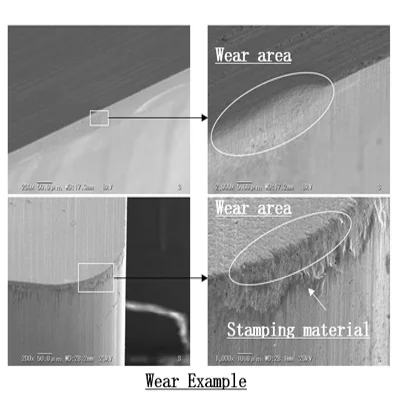
Mistake 5: No failure analysis loop. When a part fails early, the grade is only one suspect. Fit, brazing stress, mating material and operating parameters all matter. Suppliers who ask for the failed part and photos usually turn a replacement order into a life upgrade.
6. Where Custom Production Beats Catalog Parts
Standard catalog grades are a compromise by design. Custom production becomes worth it when any of the following is true:
- The wear mechanism is mixed (e.g., abrasion + impact), and no catalog grade sits at the right point on the trade-off curve.
- The part is a high-consumption item — even a 20% life improvement on 500 pieces per year repays the development quickly.
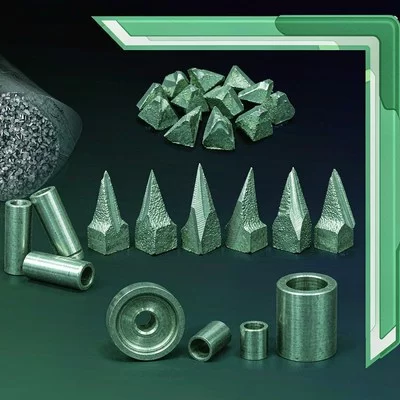
- Geometry is asymmetric or application-specific, as with mining tool tips and brazed saw tip assortments.
- You need a special form — near-net sintered bloques de electroerosión cut to size, or ground carbide rods with h5/h6 tolerance for tool making.
7. Advanced Grades: When Standard WC-Co Is Not Enough
The WC-Co system covers most wear applications, but three advanced families solve problems ordinary grades cannot:
Binderless and low-binder tungsten carbide. Removing the cobalt phase entirely (binderless WC, sintered by HIP or spark plasma sintering) produces extreme hardness — typically 93–94 HRA, or 2600–3000 HV — combined with outstanding corrosion resistance, because there is no binder phase for chemicals to attack. These grades are the choice for corrosive slurry nozzles, precision micro-bore components, and mirror-finish surfaces (Ra down to 0.01 µm after diamond lapping). The trade-off is genuine brittleness: binderless grades belong in compressive or erosive loading, never in bending or shock.
Sub-micron “dual-property” grades. Modern powder metallurgy can deliver 93+ HRA hardness together with TRS above 3000 MPa — properties that were mutually exclusive two decades ago. These grades have reshaped specifications for combined wear+impact applications such as mining picks and precision stamping punches, and they are the reason the “hardness vs. toughness” table is a snapshot, not a law of nature.
Nickel and Ni-Cr binder grades. Replacing cobalt with nickel improves corrosion resistance by an order of magnitude and is mandatory in some chemical and downhole environments. Nickel binder grades run slightly lower in hardness at equal composition and cost more, but where a cobalt-bonded part would pit and lose dimension within weeks, the nickel version is the only economic choice. Non-magnetic variants (Ni-Cu binder) are also the standard answer wherever magnetic pickup interferes with the process.
Ask your supplier which of these families they can actually produce — including the sintering equipment behind them. Capability in advanced grades is a good proxy for overall process quality, because the same powder control and sintering discipline benefit every product line.
8. Quality Checklist Before You Approve a Batch
Grade specification is only half the story; consistent execution batch after batch is the other half. Before approving a supplier or a production run, verify the following — a serious manufacturer will provide all of these without being pressed:
- Certified datasheet per shipment: density (g/cm³), hardness (HRA and/or HV30), magnetic saturation or coercivity (both are sensitive indicators of carbon balance and grain growth), and porosity class per ISO 4505.
- Dimensional report: actual measurements against the drawing, including flatness and parallelism for ground blocks and OD/ID runs for cylindrical parts — not just “within tolerance.”
- Microstructure on request: a photomicrograph of the grain structure catches abnormal grain growth that property tables can hide.
- Traceability: batch numbers linking each part back to powder lot and sintering record, so a field failure can be investigated instead of guessed at.
- Defined acceptance for critical dimensions: agreed gauging method and sample size before production starts, to avoid disputes when tolerances are tight.
These checks cost the supplier little and protect you from the most common quality failure mode in carbide buying: parts that measure correct and perform inconsistently because the underlying grade drifted between batches.
9. How We Support Grade Selection
As a carbide manufacturer with more than 20 years of production experience, we treat grade selection as part of the quotation, not an afterthought. When you send a drawing or even just the working conditions (material being processed, impact level, temperature, corrosive media), our engineers recommend a grade with the expected property values before you commit — typically within 24 hours. First samples run in 7–15 days, each batch ships with certified density and hardness data, and if field life disappoints we iterate the grade or geometry with you.
Whether the starting point is a standard wear insert, a custom crusher profile, or a blank for your own machining, the fastest path to longer part life is a short conversation about how the part actually fails — not just what it looks like. Send us your drawing or a photo of the worn part, and we will propose the grade that fits.