Carbide Saw Tips: Tungsten Carbide Material Solutions for Saw Blade Manufacturing
Every year, millions of tonnes of steel bar, structural profiles, stainless tube, aluminum extrusions, logs and panels are cut with toothed saw blades — and the cutting edge that actually meets the workpiece is almost never steel. It is tungsten carbide. From high-speed TCT circular saws in steel service centers to panel-sizing saws in furniture plants, blade makers depend on tungsten carbide saw tips to hold an edge through tens of thousands of cuts at cutting speeds no tool steel can survive.
In this article, we explain why carbide has become the standard tooth material for industrial sawing, how saw tips are made and applied, and how to select the right carbide grade for your blade application.
Why Saw Blades Demand More Than Tool Steel
Sawing looks simple, but each tooth performs a violent, repeated machining operation. A tooth on a circular saw blade cutting steel at 3,000 rpm strikes the workpiece thousands of times per minute, generating flash temperatures at the cutting edge while being cooled and heated in rapid cycles. Add abrasive workpieces such as MDF, laminate or hardened steel, and the demands exceed what high-speed steel (HSS) teeth can deliver.
The numbers make the comparison clear. An HSS circular blade cutting steel tube may need resharpening after a few hundred cuts; a TCT (tungsten carbide tipped) blade under the same conditions routinely achieves 10 to 30 times the tool life before its first regrind. Cemented carbide achieves this through a structure of tungsten carbide (WC) grains — among the hardest tool materials available — bonded with a cobalt binder:
- Extreme hardness: typically HRA 88–92.5, far beyond any HSS, so the edge resists abrasive wear from hard and abrasive workpieces.
- Hot hardness: the edge stays hard at the 600–800 °C flash temperatures typical of high-speed sawing, where HSS softens rapidly.
- Compressive strength: critical for teeth that are hammered by interrupted contact with the workpiece at every revolution.
- Brazeability: carbide wets reliably with standard silver-based brazing alloys, allowing tips to be attached to tough, shock-absorbing steel bodies.
For blade manufacturers and regrind shops, longer tooth life means fewer blade changes, more square metres or tonnes cut per blade, and a lower cost per cut — decisive advantages in high-volume sawing operations.
What Is a Tungsten Carbide Saw Tip?
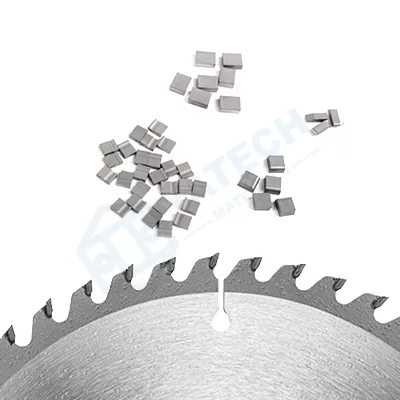
A carbide saw tip is a small, pre-sintered blank of cemented carbide, pressed into the approximate tooth geometry and then brazed into a machined seat on the steel saw body. After brazing, the teeth are ground to final geometry — clearance angle, hook angle and top-bevel. Because the tip carries the entire cutting load, its material quality and shape consistency directly determine blade performance.
Quality karbür testere uçları offer three key benefits to blade makers:
- Consistent geometry: precision-pressed and sintered tips keep size variation within a few tenths of a millimetre, so automatic brazing and grinding lines run without manual sorting.
- Controlled microstructure: uniform grain size and low porosity prevent the edge chipping and premature wear that destroy blade reputation in the field.
- Wide shape range: flat, hook, ATB (alternate top bevel), trapezoidal and custom profiles for metal, wood and special sawing applications.
Where Carbide Saw Tips Are Used
Carbide-tipped teeth are now the default across industrial sawing. The most demanding segments include:
- TCT circular saws for metal: cutting steel tube, bar, profiles and stainless steel in fabrication shops and tube mills. These blades combine a stiff steel body with fine-grain, high-hardness tips.
- Carbide-tipped band saws: for cutting large solid bars and billets, where individual carbide tips are brazed onto the toothed band for long life in demanding alloys.
- Woodworking and panel sizing: MDF, particle board, laminate flooring and plywood are highly abrasive; TCT blades dominate furniture and construction panel production.
- Friction and hot saws: in steel mills and tube plants, where tips see extreme thermal cycling and must resist both wear and heat checking.
YATECH also supplies complementary carbide cutting solutions for related processes — for example, tungsten karbür dilimleme bıçakları for high-speed metal slitting and cut-to-length lines, where the same wear-resistance principles apply to continuous rather than interrupted cutting.
Doğru Karbür Kalitesi Nasıl Seçilir
Grade selection is the most important engineering decision when specifying saw tips. It is a trade-off between wear resistance and toughness, controlled mainly by grain size and cobalt content.
Tane büyüklüğü
- İnce taneler (0,8–1,3 µm): the workhorse for metal-cutting TCT blades — high hardness for abrasive steels and stainless, with adequate edge stability.
- Mikron altı ve ultra ince taneler (0,2–0,8 µm): maximum hardness and edge sharpness for thin-kerf blades and abrasive non-ferrous or panel cutting.
- Orta taneler (1,3–2,5 µm): greater toughness for coarse-tooth blades, friction saws and applications with heavy impact loading.
Kobalt İçeriği
- %6–8 Co: standard for metal-cutting and panel blades where maximum wear resistance matters most.
- 10–12% Co: better impact resistance for band saw tips, coarse woodcutting and rough sawing of difficult alloys.
- Ni veya Ni-Cr bağlayıcılar: for corrosive environments such as wet wood or treated timber, where standard Co binder would degrade.
A practical starting point: for steel tube and bar cutting, begin with a 6–8% Co fine-grain grade; for abrasive panel materials, an ultra-fine 6% Co grade maximizes runs between regrinds; for band saw applications on large billets, move toward 10–12% Co for edge toughness. Our tungsten karbür kaliteleri referansı standart bileşimlerin tamamının ayrıntılarını verir.
Yaygın Arıza Modları ve Bunlardan Nasıl Kaçınılacağı
Even the best carbide will fail early if the blade system around it is wrong. Watch for these issues:
- Tooth chipping: usually caused by excessive feed, vibration or workpiece clamp movement. Tip toughness must match the machine’s stability — a fragile ultra-fine grade on a loose sawing line will chip no matter how hard it is.
- Heat checking: thermal cracks from rapid heating and cooling cycles. Correct coolant flow, feed rate and, where needed, grades with better thermal shock resistance solve this.
- Brazing defects and tooth loss: poor wetting or excessive braze temperature embrittles the carbide surface. Consistent tip flatness and clean seat preparation are as important as the braze alloy itself.
- Rapid flank wear: often a sign the grade is too soft for the workpiece, or that clearance angles are ground incorrectly, rubbing instead of cutting.
Working With a Carbide Saw Tip Supplier
Consistency batch after batch is what separates a reliable saw tip supplier from a commodity seller. At YATECH MATERIALS, we control the full production chain — from tungsten powder through spray drying, pressing, sintering and quality inspection — and supply saw tips in standard and custom geometries with tight dimensional tolerances and stable, documented grades. Beyond saw tips, the same material platform supports our broader range of tungsten karbür aşınma parçaları for industries from metalforming to mining.
If you are a blade manufacturer or regrind service looking to improve tooth life, or you need custom tip profiles for a new sawing application, teknik ekibimizle iletişime geçin for a tailored grade recommendation and quotation.