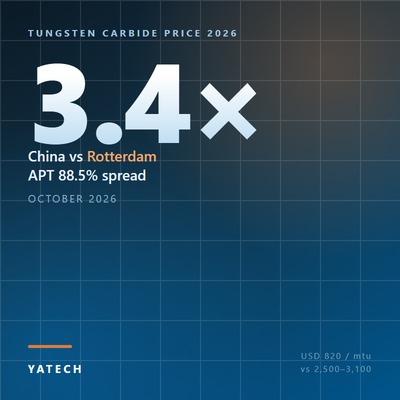
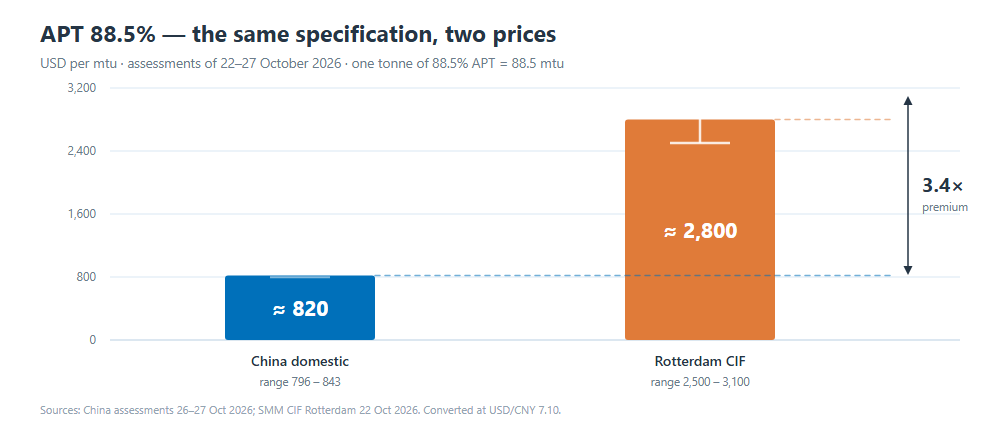
On 27 October 2026, tungsten carbide powder in China was quoted at RMB 720–760 per kilogram. The same powder, priced off European ammonium paratungstate, works out to roughly USD 315–390 per kilogram — about three times as much. APT itself trades at about USD 820 per mtu in China, against USD 2,500–3,100 per mtu in Rotterdam. This is not a transient arbitrage. It is the shape of the market that buyers now have to plan around.
This article breaks down where tungsten prices actually sit today, what China’s export control regime does and does not cover, and why the price of a sintered carbide blank has decoupled from the price of the powder inside it.
Tungsten prices on 27 October 2026
Chinese domestic prices have corrected hard from the March 2026 spike and are now consolidating. Offshore prices have barely moved. The table below uses the most recent published assessments.
| Material | China domestic (RMB) | China (USD equiv.) | Overseas benchmark |
|---|---|---|---|
| Tungsten concentrate, 55% WO₃ | 320,000–340,000 / std t | — | — |
| APT, 88.5% WO₃ | 500,000–530,000 / t | ~796–843 / mtu | 2,500–3,100 / mtu, CIF Rotterdam |
| Tungsten metal powder | 760–800 / kg | 107–113 / kg | — |
| Tungsten carbide powder | 720–760 / kg | 101–107 / kg | ~315–390 / kg (derived from APT) |
| Ferro-tungsten, 70% | ~510,000 / t | ~103 / kg W | 158–165 / kg W (Europe) |
Units. t = metric tonne; kg = kilogram; std t = standard tonne of concentrate normalised to 65% WO₃ — a 55% concentrate therefore settles at roughly 0.85 of the quoted per-tonne rate; mtu = metric ton unit = 10 kg of WO₃, so one tonne of 88.5% APT contains 88.5 mtu and 1 mtu of APT is about USD 820 in China today; kg W = kilogram of contained tungsten, which is why 70% ferro-tungsten at RMB 510,000/t (RMB 510/kg of alloy) equals about USD 103/kg W.
Sources and conversion. China assessments 26–27 October 2026; Rotterdam APT 22 October 2026. USD conversions at an indicative USD/CNY 7.10. The European carbide powder figure is derived — Europe does not publish a liquid powder quote — by converting Rotterdam APT at 1.336 t APT per tonne of WC (WC is 93.8% W; 88.5% APT is 70.2% W) and adding a typical USD 20/kg conversion cost. Treat it as an order of magnitude, not a quotation.
Two markets, one metal
For most of the last two decades, Chinese and European APT tracked each other within a few percent. In September 2024 both sat near USD 300–330 per mtu. Then the two series tore apart.
Between September 2024 and the 2026 peak, European APT went from about USD 300 to USD 3,000 per mtu — a tenfold move. Chinese APT rose too, from roughly RMB 205,000 to a peak near RMB 1.5 million per tonne — the equivalent of about USD 2,420 per mtu at today’s exchange rate. When Chinese domestic prices collapsed through Q2 and Q3 2026, Rotterdam held. Today the spread is about 3.4x.
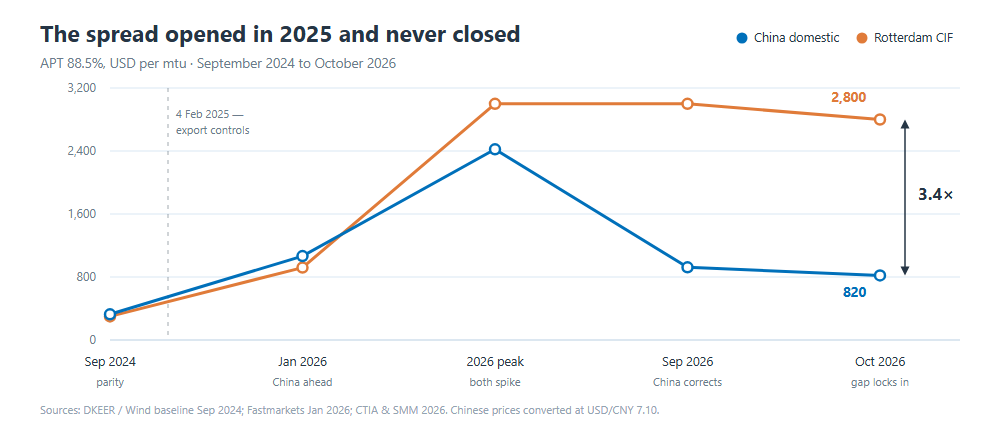
Three things explain the persistence of that spread, and none of them is a mining accident:
- Licensing. Offshore buyers cannot buy Chinese APT or unsintered carbide powder without an export licence, and licences are issued to a small pool of authorised companies.
- No new spot cargo. European traders describe the same dynamic repeatedly: as long as China does not release raw material offshore, no fresh low-priced spot tonnes appear, and the market simply has no transactions to price against. Thin liquidity becomes a permanent premium.
- Strategic restocking. The US Defense Logistics Agency signed a tungsten stockpile contract worth roughly USD 2 billion in 2026, and Western toolmakers are building inventory rather than running hand-to-mouth. Sandvik reported powder order intake more than doubling year on year for two consecutive quarters.
What China’s tungsten control regime actually covers
The framework is three layers deep, and buyers routinely conflate them:
Layer 1 — dual-use export control. Announcement No. 10 of 2025 (MOFCOM and GACC, effective 4 February 2025) extended controls from large missile-related tungsten shapes down to smelting feedstock. Code 1C117.d covers ammonium paratungstate, tungsten oxides, and unsintered tungsten carbide — including simple mixtures and powder blends. Code 1C117.c covers solid tungsten and high-performance alloys above defined composition and machinability thresholds. The related process technology sits under 1E004 and 1E101.b, and it is controlled even when it leaves China as an email or a drawing rather than a shipment.
Layer 2 — state trading. Tungsten concentrate, APT, tungsten oxides, tungsten powder and carbide powder may only be exported by companies on the MOFCOM list. For 2026–2027 that list contains 15 companies. Every other exporter in China has to route through one of them. Qualification requires banking credit lines above RMB 200 million and a documented export record — the stated purpose is to remove shell traders and concentrate the licence pool.
Layer 3 — country-specific measures. From 6 January 2026, dual-use exports to Japanese military end users and military end uses are prohibited outright, with entity lists issued in February 2026. In October 2026 MOFCOM and GACC issued Announcement No. 52 refining how disputed classifications are challenged and appraised. The direction of travel is regulatory refinement, not relaxation.
The commercial result: raw material leaving China carries a scarcity premium plus a compliance cost, and the number of parties who can legally ship it keeps shrinking.
The line most buyers miss
Here is the part that matters for anyone buying parts rather than powder. Sintered tungsten carbide is not on the 1C117.d list. Neither are finished carbide tools. MOFCOM’s own guidance on common products identifies the following as outside dual-use control:
- Already-sintered tungsten carbide, and carbide plates, blocks, rods, balls
- Cermets, carbide alloy powders, and carbide scrap
- Carbide drills, inserts, end mills, saw blades and mining bits made from carbide
- Tungsten wire, tungsten hooks, stamping dies and similar finished tooling
- Ammonium metatungstate (still subject to a general export licence, but not a dual-use item)
The reasoning given is technical, not political: once carbide is pressed and sintered it is a finished or near-finished hardmetal part, no longer a feedstock that can be reduced back into tungsten material, and it cannot be machined into the large cylindrical or tubular shapes the control list targets.
Downstream hardmetal products are also outside the state-trading catalogue. Any Chinese manufacturer with foreign trade rights can export sintered blanks, wear parts, dies, rolls and nozzles directly — no state trader in the middle, no licence queue.
That is the structural gap. The control regime has made powder expensive and slow to obtain offshore, while leaving the export channel for sintered parts open and priced off Chinese domestic cost. A buyer who needs carbide wear parts is not competing for a licensed raw material allocation. A buyer who needs powder is.
Why the advantage is structural rather than temporary
Material is the dominant cost in a cemented carbide part — typically 60–75% of the ex-works cost of a wear component, more for heavy sections. That cost is now set in two different markets, and the Western market has acquired a stack of adders that the Chinese one does not carry:
- A German carbide toolmaker introduced a weight-based raw material surcharge (RTZ) on all carbide tooling from 1 May 2026.
- A major Japanese supplier raised prices twice in 2026, with selected grades up 15–25% and some lines moved to non-stocked special items.
- The European Cutting Tool Association is lobbying for tungsten scrap to be retained inside Europe, which raises secondary feedstock costs there rather than lowering them.
- Kennametal added USD 700 million of liquidity specifically to fund tungsten-related working capital.
On the supply side, the deficit is not closing quickly. China holds roughly 47% of global tungsten reserves and around 78% of mine production, and domestic concentrate output fell 14.75% year on year to 53,700 tonnes in H1 2026 under the mining quota system. CICC projects a global shortfall of 22,000–25,000 tonnes of tungsten metal for 2026–2029 — around 13–14% of annual consumption — with new demand from AI-server PCB drills and photovoltaic tungsten wire layered on top of traditional cutting tools.
Translated to the shop floor: a 3/8-inch reference tool that cost about USD 35 in 2024 is being quoted at USD 80–90 in 2026. Chinese sintered blanks have risen too, but from a base one third as high.
Where substitution already works — and which grade covers which part
The honest answer is that Chinese carbide blanks are a drop-in replacement in most wear and blanking applications, and a partial one in high-end metal cutting. Two product groups have moved fastest in 2026, because both can be qualified on a single test batch:
- Carbide rods — ground and unground, Ø1–56 mm, 310/330 mm long, in seven grades from 6% to 12% cobalt. Rod is the most liquid hardmetal product in the world, which makes it the easiest place to start: same ISO class in, same tool performance out, at roughly a third of the material cost.
- Gear cutting tool blanks — hob and shaper-cutter blanks to drawing: 25.8–50.8 mm OD, 9.6–21.6 mm bore, 30–35° pressure angle, 12 teeth, 20–180 mm long, plus disc blanks from 16–85 mm OD up to 330 mm. Gear tooling is a sub-micron job — YU092 at 0.2 µm and 94.0 HRA for finishing above HRC 58, YU20 at 0.7 µm and 91.8 HRA for general hobbing.
Every grade below is a production grade with published lot data, not a catalogue reference. Match on the failure mode first — abrasion, impact, corrosion, or edge build-up — and use the ISO class as a cross-check, not the other way round.
| Grade | ISO | Binder · grain | HRA | Parts it covers / replaces |
|---|---|---|---|---|
| YU092 | K05‑K10 | 9% · 0.2 µm | 94.0 | Rod, gear cutting tool blanks, insert blanks; finishing hardened steel above HRC 58 |
| YU10UF | K05‑K10 | 6% · 0.4 µm | 94.0 | Rod, PCB drills and gravers, composite finishing |
| YU15UF | K10‑K20 | 8.5% · 0.4 µm | 93.5 | Rod, end mills, PCB cutters |
| YU25UF | K20‑K40 | 12% · 0.4 µm | 92.6 | Rod; milling stainless steel, titanium and HRC 50–58 tooling |
| YU20 | K20‑K40 | 10% · 0.7 µm | 91.8 | Rod, gear cutting tool blanks; general drills and end mills |
| YK05A | K15 | 6% · 1.0 µm | 92.5 | Rod and strips for non-ferrous metals and high-silicon aluminium |
| YF40H | — | 12.5% · 1.0‑2.0 µm | 89.5 | EDM blocks and plates; motor-rotor stamping dies |
| YF50H | — | 14% · 1.5‑3.0 µm | 88.5 | EDM blocks; brushless and servo rotor cores |
| YA20 | — | 13.5% · 0.5‑1.5 µm | 90.0 | EDM plates; thin stainless and copper stamping dies |
| YA30 | — | 12% · 1.0‑2.0 µm | 91.2 | High-speed precision stamping of strip ≤ 0.2 mm |
| YG6 | K10 | 6% · 1.5 µm | 92.5 | Saw tips, nozzles, non-standard wear parts |
| YG8 | K20 | 8% · 1.5 µm | 90.0 | Wear plates, saw tips, structural parts |
| YG15 | K40 | 15% · 1.5 µm | 87.0 | Heavy-stress wear parts and forming tools |
| YG20 | G40 | 20% · 1.5 µm | 85.0 | Stamping dies, battery-shell dies, cold heading |
| YF06N | — | 6% Ni · 1.5 µm | 92.5 | Seal rings, valve balls, acid and submersible pumps |
| YGR20‑YGR60 | — | 10.5‑30% · 3.0‑3.5 µm | 77.5‑84.0 | Roll rings by mill stand, finishing to intermediate |
| YK06 / YK10 / YK11 | — | 6‑11% · fine‑medium | 87.7‑90.0 | DTH bits, cone bits, reamer bits |
| CG5 / CG6 | — | 12‑14% · medium | 87.3‑88.3 | Cold heading dies, high-toughness forming tools |
| CA18‑CA24 / CT15‑CT20 | — | 18‑24% · coarse | 82.5‑85.1 | Screw dies, warm and hot forging dies |
Typical values only. Beyond rod and gear blanks, the same grades cover insert blanks, saw tips, EDM blocks, cold heading dies, drawing dies, roll rings, wear plates and liners, nozzles and mining bits — the categories where the part is a consumable with a measurable wear life and the qualification cycle is short, which is what makes the 3x material gap show up in the price.
If you are starting from a grade decision rather than a part number, the tungsten carbide grades selection guide maps every family to binder content and application, and the blanks overview shows what is supplied as sintered stock versus finished-ground.
Five things to check before you switch supplier
- A written control-status statement. Ask your supplier to confirm in writing that the part is sintered and falls outside 1C117.d and 1C117.c, referencing the announcement. This protects you if customs queries the shipment.
- Correct HS classification. Sintered carbide parts and unsintered powder are classified differently, and misclassification is the most common cause of a held shipment.
- Mill test certificate, not a datasheet. You want Co content, WC grain size (FSSS), density, hardness in HRA and transverse rupture strength for the actual lot.
- Porosity and metallography. ISO 4505 porosity ratings of A02/B00 or better, plus a photo of the microstructure, separate a real hardmetal producer from a trader.
- Lot-to-lot spread. Request hardness and density from three consecutive lots. A 1.5 HRA spread on a K20 grade is the difference between 20,000 and 8,000 parts per edge in a stamping die.
Bottom line
The October 2026 market rewards buyers who understand the difference between a controlled material and a controlled product. APT and unsintered carbide in China are licence-gated, state-traded and effectively three times more expensive once they leave the country. Sintered carbide blanks and finished wear parts are neither licensed nor state-traded, and they are still priced against a domestic cost base that sits at one third of the European level.
That is not a loophole and it is not a discount. It is two different markets for the same metal, and the gap has been widening for twenty months.
Need a sintered blank or wear part quoted against today’s material cost? Send us the drawing — grade, dimensions and expected life are enough to come back with a price and a sample plan.
FAQ
Can tungsten carbide still be exported from China in 2026?
Yes, but the rules differ by product stage. APT, tungsten oxides and unsintered tungsten carbide require a dual-use export licence and may only be exported by companies on the MOFCOM state-trading list — 15 companies for 2026–2027. Sintered carbide blanks, wear parts, inserts, drills and similar finished hardmetal products are not dual-use items and are not in the state-trading catalogue, so any manufacturer with foreign trade rights can export them.
Why is European APT three times the Chinese price?
Because the two markets are supplied through different channels. Chinese domestic APT is freely traded inside China; offshore APT has to come through a licensed export, so no new low-priced spot cargo reaches Rotterdam. With thin liquidity and strategic stockpiling on both sides, quotes hold near USD 2,500–3,100 per mtu while Chinese material trades at an equivalent of roughly USD 820 per mtu.
Will tungsten carbide prices return to 2024 levels?
Unlikely in the near term. Chinese domestic prices have already corrected about two thirds from the Q1 2026 peak, but they remain well above the September 2024 baseline, and the projected 2026–2029 supply deficit of 22,000–25,000 tonnes of tungsten metal keeps a floor under the market. The offshore premium is a policy outcome, so it lasts as long as the licensing regime does.