
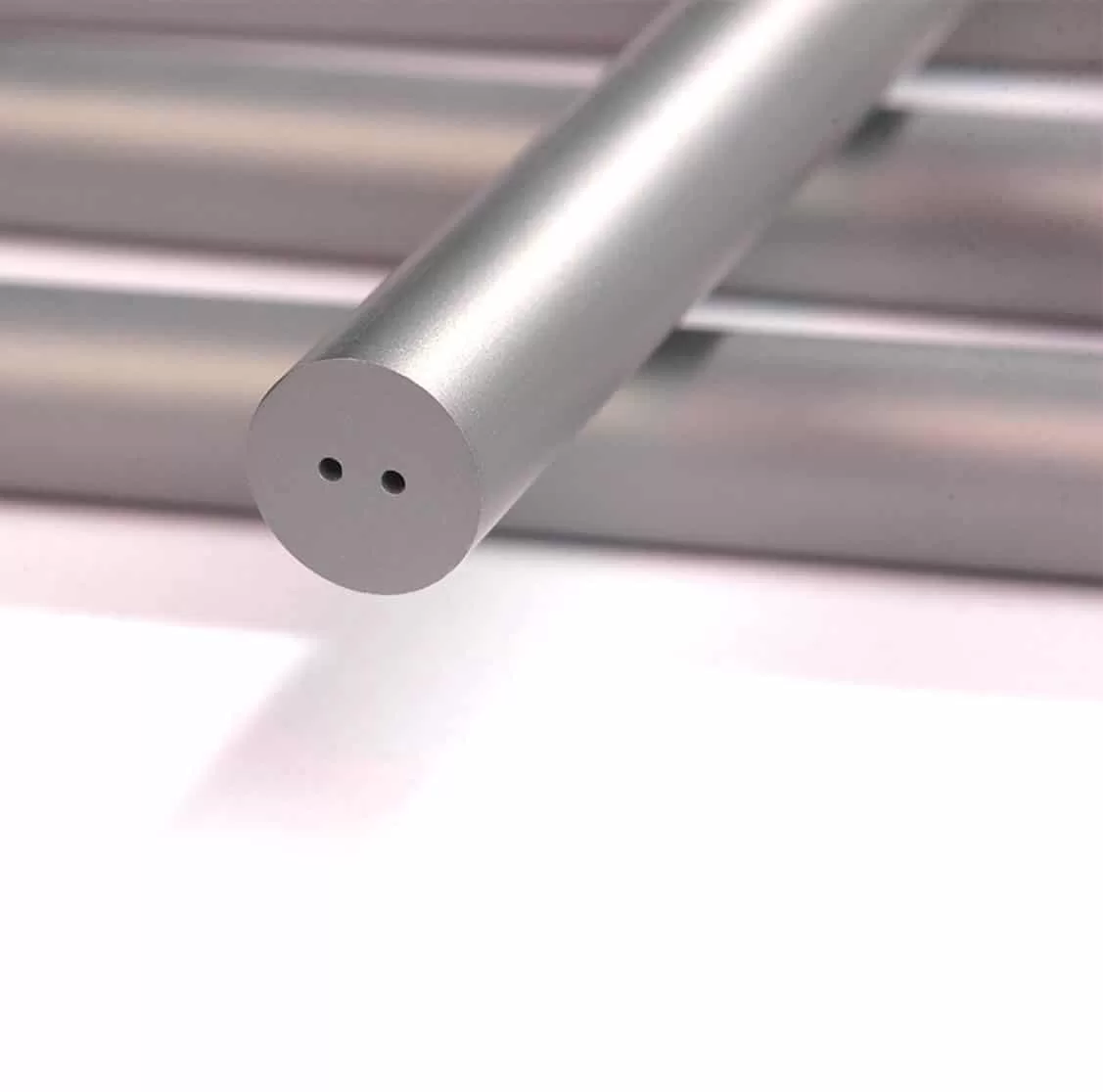
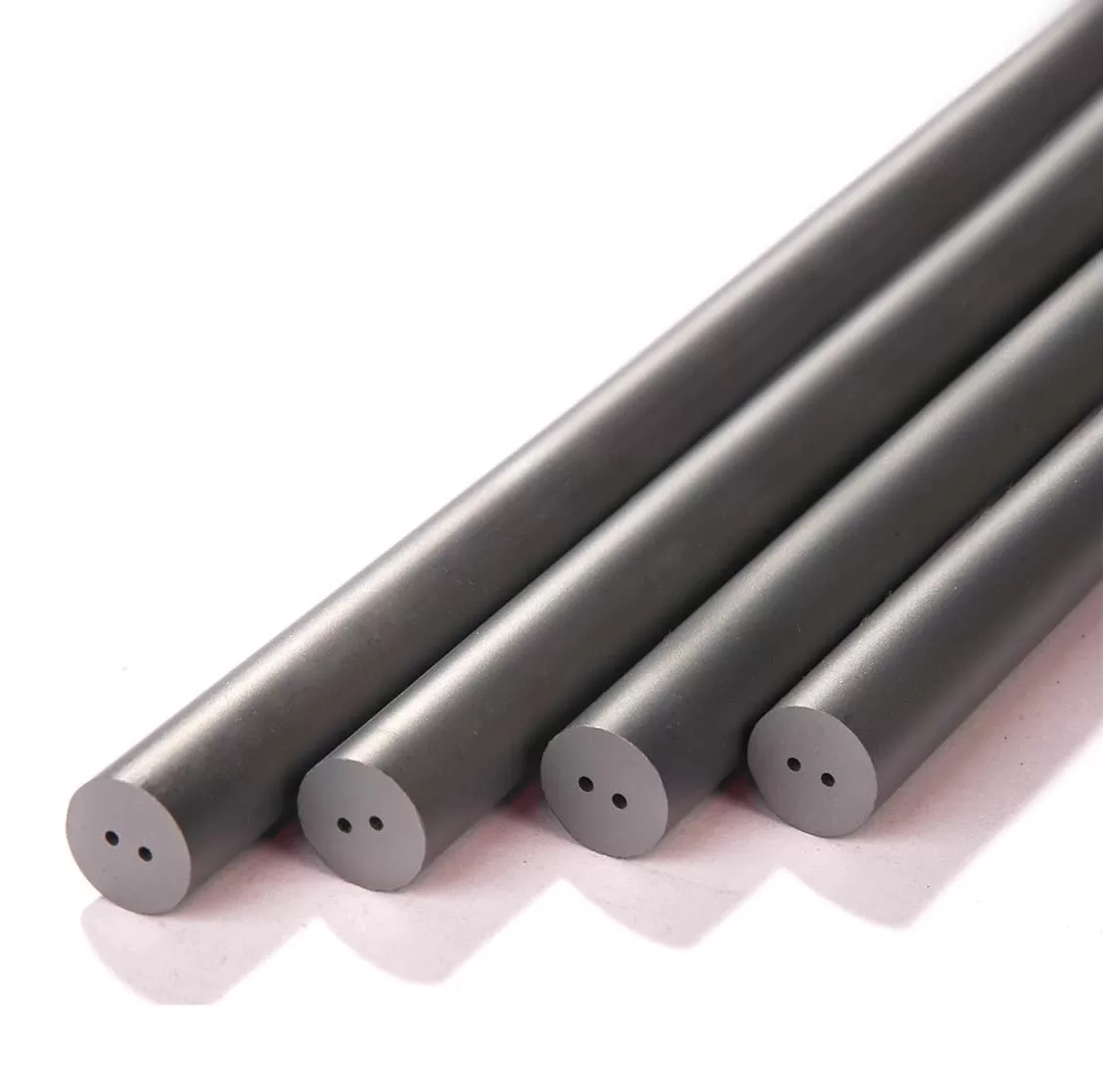
Tungsten carbide straight coolant rods carry one or two bores parallel to the axis, so coolant leaves at the flat end face instead of following a flute. They are the blank behind gun drills, reamers, boring bars and form tools — tools that get rodded out and inspected between regrinds, where a bore that never wanders matters more than coolant volume. Yatech forms both patterns in the green compact, sinters and HIPs the rod, then centerless-grinds to h6 in 330 mm, with 310 mm stock for shrink-fit holders.
Why a straight bore instead of a helix
A helical bore follows the flute. That is what a twist drill needs, and it is what a helical coolant-hole rod is for. A straight bore does the opposite: the bore stays in the same position from shank to tip, which makes the rod easy to inspect, easy to clean and impossible to mismatch against a straight-flute grind.
The trade is flow. A straight bore cannot be brought as close to the cutting edge on a helical tool, so for a twist drill the helix still wins. Where the tool is reamed, formed or ground with straight flutes, the straight pattern gives back what the helix costs: wall thickness, straightness, and a bore you can see through.
Both patterns are formed by the die at pressing. No amount of grinding later can move a bore, thin a web or fix a wall that was specified too thin — which is why the pattern is settled on the drawing before the order is released.
One bore or two — pick by the tool
Bore diameter scales with the outside diameter: about 20 % of Ø for a single central bore, about 17.5 % of Ø for two. If you need more coolant flow than that, the answer is a larger rod, not a larger bore. The web carries the bending load, and a thin web is what breaks a gun drill at 10×D.
| Pattern | Bore Ø vs rod Ø | Web | Where it wins | Typical tool |
|---|---|---|---|---|
| 1 hole, on axis | ≈ 0.20 × Ø | ≈ 0.40 Ø on every side | Thickest wall of any pattern, highest bending strength, best straightness after grinding | Gun drills Ø4–12, single-flute drills, long-reach boring bars |
| 2 holes, straight | ≈ 0.175 × Ø | ≈ 0.30 Ø between bores | More flow in the same diameter, and both bores can be rodded out and inspected | Reamers, form tools, two-flute gun drills, coolant-through holders |
Two straight bores sit on a pitch of about 0.47 Ø and are placed symmetrically, so the section stays balanced and the rod does not pull to one side during centerless grinding. Check the pitch against your flute core before you release the order.
1 hole on the axis — standard sizes
Ground h6, 330 mm as standard. Weight is calculated at 14.45 g/cm³ net of the bore volume, so it is the figure to use for freight and for spindle load.
| Rod Ø (mm) | Bore Ø (mm) | Wall (mm) | kg/m | Order code |
|---|---|---|---|---|
| 4 | 0.80 | 1.60 | 0.17 | YCH-0400 |
| 6 | 1.20 | 2.40 | 0.39 | YCH-0600 |
| 8 | 1.60 | 3.20 | 0.70 | YCH-0800 |
| 10 | 2.00 | 4.00 | 1.09 | YCH-1000 |
| 12 | 2.40 | 4.80 | 1.57 | YCH-1200 |
| 16 | 3.20 | 6.40 | 2.79 | YCH-1600 |
| 20 | 4.00 | 8.00 | 4.36 | YCH-2000 |
2 holes, straight — standard sizes
Same material, same grinding class. The bores are parallel to the axis and exit on both end faces, which is what makes the pattern serviceable in the tool room.
| Rod Ø (mm) | Bore Ø (mm) | Pitch (mm) | Web between bores (mm) | kg/m | Order code |
|---|---|---|---|---|---|
| 4 | 0.55 | 1.80 | 1.25 | 0.18 | YCH-0400 |
| 6 | 0.80 | 2.70 | 1.90 | 0.39 | YCH-0600 |
| 8 | 1.10 | 3.60 | 2.50 | 0.70 | YCH-0800 |
| 10 | 1.35 | 4.50 | 3.15 | 1.09 | YCH-1000 |
| 12 | 1.60 | 5.40 | 3.80 | 1.58 | YCH-1200 |
| 16 | 2.15 | 7.20 | 5.05 | 2.80 | YCH-1600 |
| 20 | 2.70 | 9.00 | 6.30 | 4.37 | YCH-2000 |
Sizes between the table rows are not a problem. The bores are formed by the die, so any outside diameter inside the envelope can be paired with either pattern in the same size class — send the diameter and the bore you want and we check it against the die before quoting.
Tolerances held on every rod
| Feature | Standard | On request |
|---|---|---|
| Outside diameter | Ground h6 | h5 or h7; unground at +0.3 mm on diameter |
| Bore diameter | ±0.05 mm | Held on the same band for both bores in a 2-hole rod |
| Bore position | ±0.15 mm | Tighter by agreement on a drawing dimension |
| Straightness | 0.05 mm per 100 mm | Tighter than solid rod, because any bend shows up as an off-centre exit after grinding |
| Length | 330 mm | 310 mm for shrink-fit holders; cut lengths to order |
| Ends | Ground square, chamfered, bore visible on the face | Graphite insert fitted for brazing, or bore left open for coolant-through holders |
The 0.05 mm straightness figure is not a catalogue formality. Grind the flutes on a bent rod and the exit lands off the flute centre; the tool then loses coolant exactly where it is hottest. Straight-bore rod is held to the same 0.05 mm per 100 mm as helical-bore rod, and that is the reason.
Grades for straight coolant rods
Coolant-hole rod is supplied from the YU, YM and YS families. For gun drills and reamers the choice is usually about toughness and edge stability together, not hardness alone — a grade that chips at the bore exit loses the tool before the bore wears out.
| Grade | ISO | Co % | Grain (µm) | Hardness HRA | TRS N/mm² | K1C MPa·m1/2 | Where it fits |
|---|---|---|---|---|---|---|---|
| YU25UF | K20–K40 | 12 | 0.4 | 92.6 | 4 200 | 9.9 | Gun drills and reamers in interrupted or unstable cuts |
| YU20 | K20–K40 | 10 | 0.8 | 91.9 | 4 000 | 10.5 | General drilling and reaming, the default for long reach |
| YU15UF | H10–H20 | 8.5 | 0.4 | 93.2 | 4 300 | 9.6 | Hardened steel above 45 HRC, form tools |
| YU092 | K05–H10 | 9 | 0.2 | 94.0 | 4 100 | 9.1 | Sub-micron grade for finishing reamers and small bores |
| YU10UF | K05–K10 | 6 | 0.4 | 94.0 | 3 800 | 9.2 | Wear resistance where the cut is stable, abrasive workpieces |
| YMR12T | M20–M40 | 12 | 0.7 | 91.8 | 4 100 | 11.5 | Stainless and duplex, where built-up edge is the failure mode |
| YSR11B | S20–S40 | 11 | 0.8 | 91.5 | 4 100 | 12.1 | Inconel, titanium and heat-resistant alloys |
Typical values for sintered and HIP material, not guaranteed minima. Hardness to ISO 3878, TRS on ISO 3327 B-size test bars, K1C by Palmqvist on polished sections. Certified density, hardness and TRS data accompany every batch.
How the bore is formed
The bore is not drilled. A mandrel sits in the die, powder is pressed around it, and the hole exists as soon as the compact does. That is what keeps the wall concentric over 330 mm, and it is also why the pattern cannot be changed after the order: by the time the rod reaches the grinder, the geometry is fixed in the material.
After pressing, the rod is CIP-consolidated for uniform density, sintered and HIPed to close residual porosity, then centerless-ground to the diameter class. Through-bores stay open through every step, so the finished rod shows the bore on both end faces — the cheapest inspection you will ever do on a coolant rod.
How to specify a straight coolant rod
The order code reads left to right: YCH-0800-330-H6 is a coolant-hole rod, Ø8.00 mm, 330 mm long, ground h6. Because both patterns share the YCH family prefix, the pattern and the bore diameter have to be named on the order line rather than decoded from the code — one line per item is enough:
| What we need | Example |
|---|---|
| Outside diameter and tolerance class | Ø8.00 mm, h6 ground |
| Pattern | 1 hole on axis, or 2 holes straight |
| Bore diameter | 1.10 mm ±0.05 |
| Length | 330 mm standard, 310 mm for shrink-fit, or cut to length |
| Grade | YU20, or the grade you already run |
| Quantity and repeat rate | Pieces per order, pieces per year |
Lead time for stock sizes is 7–12 working days. A non-standard diameter in an existing grade runs 15–25 working days; a new die or a grade we do not hold runs 25–35 working days, counted from drawing approval. Samples from production tooling are available before a volume order.
Not sure whether the tool wants one bore or two? Send the finished tool drawing — flute count, core diameter and reach are enough for us to say which pattern survives the grind. If the tool is a twist drill rather than a gun drill or reamer, the helical coolant-hole rod is almost always the better blank.
Frequently Asked Questions
What is a tungsten carbide straight coolant rod?
A solid carbide rod with one or two bores running parallel to its axis, so coolant enters at one flat end face and leaves at the other. Straight-bore rod is used for gun drills, reamers, boring bars and form tools, where the tool is ground with straight flutes and the bore has to stay in the same position from shank to tip. It is supplied ground h6 in 330 mm, with 310 mm stock for shrink-fit holders.
Should I choose one bore or two?
Take one central bore when reach and bending strength matter most: it leaves the thickest wall of any pattern, which is what a gun drill at 8-10xD needs. Take two straight bores when you need more flow in the same diameter, or when the bores have to be rodded out and inspected between regrinds. Both bores in a 2-hole rod are held to the same diameter band, so neither side runs lean on coolant.
Can the coolant holes be drilled after sintering?
No. The bores are formed in the green compact by a mandrel in the pressing die, so the pattern and the bore position are fixed before the rod is sintered and ground. That is deliberate: a pressed bore keeps its wall concentric over the full length, while a hole drilled into a sintered rod is slow, expensive and prone to breakout at the exit. It also means the pattern cannot be changed once the order is released.
What bore diameter comes with each rod size?
About 20 % of the outside diameter for a single central bore and about 17.5 % for two bores. A 8 mm rod carries a 1.60 mm bore with one hole, or two 1.10 mm bores on a 3.60 mm pitch. If you need more flow than that ratio allows, go up a rod size rather than up a bore: the web between the bore and the outside diameter is what carries the bending load.
Do you supply lengths other than 330 mm?
330 mm is standard for both patterns. Straight-bore rod is also available in 310 mm for shrink-fit holders, and cut lengths are supplied to order within what the die allows. Ends are ground square and chamfered and the bore is visible on the face, so the rod can be checked on arrival without sectioning it.
Which grades are available for straight coolant rods?
The YU, YM and YS families. YU20 and YU25UF cover general drilling and reaming; YU092 and YU10UF suit finishing reamers and abrasive work; YMR12T is for stainless and duplex, and YSR11B for Inconel and titanium. Hardness, TRS and toughness values for each grade are listed on the page and in our tungsten carbide grades section.
How do straight coolant rods differ from helical coolant-hole rods?
The helix follows the flute, so a helical bore delivers coolant closer to the cutting edge on a twist drill or end mill. A straight bore stays parallel to the axis, which suits tools ground with straight flutes and makes the bore inspectable. If the tool is a twist drill, take the helical pattern; if it is a gun drill, reamer, boring bar or form tool, take the straight pattern.
What is the minimum order and lead time?
There is no fixed MOQ for standard sizes in grades we hold. Stock sizes run 7-12 working days; a non-standard diameter in an existing grade 15-25 working days; a new die or a new grade 25-35 working days from drawing approval. Samples from production tooling can be supplied before a volume order.
Get a Quote for Tungsten Carbide Straight Coolant Rods
Related tungsten carbide products
Straight coolant rod is one blank in a wider rod range. The rest of the family:
- Solid Tungsten Carbide Rods — no bore, the highest bending load of any pattern
- Carbide Rods — solid ground and unground rod, h5 to h7, from Ø1.0 mm
- Helical Coolant Hole Rods — 30° and 40° helix, 2 and 3 holes, for twist drills and end mills
- Tungsten Carbide Grades — full grade data, ISO classes and selection matrix
- Carbide Tool Blanks — preforms pressed to drawing for gear cutters, inserts and specials