Walk through any steel service center, copper foil mill or battery electrode coating line and you will find rotary slitting at the heart of production: wide coils enter, narrow mults leave — cut by two opposed circular knives that shear the same edge hundreds of thousands of times per shift. When those knives are tool steel, edge wear, burr growth and unscheduled knife changes quietly tax every tonne processed. That is why more coil processors are specifying ножи для продольной резки из карбида вольфрама for demanding metal slitting.
Below, we explain where carbide pays for itself and how to select the grade, tolerances and knife setup that deliver clean, burr-free slit edges.
Why Metal Slitting Is Harder on Knives Than It Looks
Rotary slitting looks simple: two circular blades overlapping like scissors. In practice:
- Extremely small working clearances. Knife clearance is typically 5–10% of strip thickness — a few hundredths of a millimetre for 0.2 mm foil — so any runout larger than this appears immediately as burr or double-cut edges.
- Continuous side loading. As the strip shears, it forces the knife flanks apart, so worn or poorly supported knives deflect and smear the slit edge.
- Millions of cuts per shift. A line running 150 m/min makes hundreds of thousands of knife engagements per shift — wear is continuous, not intermittent.
- Unforgiving quality specifications. Downstream stamping, winding and stacking demand burr heights below roughly 0.02–0.05 mm and stable widths — coil after coil.
Tool steel can be hardened beyond HRC 60, but it loses its edge quickly against abrasive silicon steel or gummy copper alloys. As the edge dulls, burr height climbs until the knife is pulled and reground — hours of unplanned downtime on a high-speed line.
What Is a Tungsten Carbide Slitter Blade?
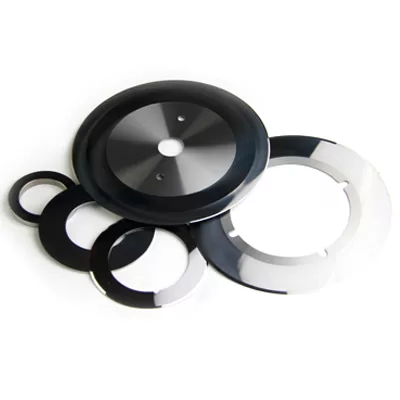
A tungsten carbide slitter blade is a circular knife sintered from tungsten carbide (WC) grains bonded with cobalt, then precision ground and mirror-polished to a razor edge. Compared with tool steel, cemented carbide offers:
- Far higher hardness: typically HRA 86–93 depending on grade, retained even as operating temperature rises.
- Many times longer edge life: carbide edges last 5 to 20 times longer between regrinds than hardened tool steel.
- High stiffness: an elastic modulus of roughly 600 GPa — three times that of steel — keeps the edge from deflecting under side load and holds width tolerance.
- No heat treatment: carbide is sintered to final hardness, so dimensional stability is inherent.
YATECH MATERIALS supplies slitter blades in OD 20–340 mm, ID 3–280 mm and thickness 1.6–30 mm, ground to flatness within 0.005 mm, concentricity within 0.05 mm and cutting-edge Ra 0.1–0.2 µm — individually or as matched male/female knife-and-die sets with spacer stacks. See the full size range, tolerance table and grade matrix on our carbide slitter blade product page.
Where Carbide Slitter Blades Earn Their Keep
Carbide slitting knives are the default choice wherever edge quality and knife life decide economics:
- Electrical steel (silicon steel): motor and transformer laminations are thin, hard and abrasive; burr control directly affects core stacking and interlaminar insulation.
- Copper and aluminum foil and battery electrode: strip below 0.1 mm demands a mirror edge and burr-free cut — especially on lithium battery pole piece lines where particles cannot be tolerated.
- Stainless and high-strength steel strip: work-hardening alloys that would dull a tool steel knife within a single shift.
- Corrugated board, film, tape, nonwovens and tobacco: the same blade family serves non-metallic webs where abrasion rather than shear stress dominates.
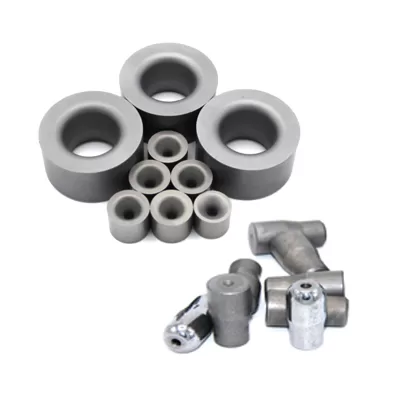
For adjacent coil-processing operations, YATECH also produces tungsten carbide rolls for wire rod and strip rolling mills.
Как выбрать правильную марку твердого сплава
Grade selection is the most important engineering decision — a trade-off between wear resistance and toughness, controlled by grain size and cobalt content.
Размер зерна
- Sub-micron and ultra-fine grains (0.2–0.8 µm): maximum hardness and the sharpest sustainable edge — for foil, battery electrode and other thin, burr-critical webs.
- Fine grains (0.8–1.3 µm): the balanced choice for most metal strip slitting — strong wear resistance with enough edge stability to survive occasional side load.
- Medium grains (1.3–2.5 µm): greater toughness for corrugated board, composites and other abrasive, high-vibration webs.
Содержание кобальта
- 6–8% Co: hardest grades for thin foil and electrode slitting — YATECH YA05U (sub-fine grain, 6% Co) reaches HRA 92.8–93.2, the sharpest edge in our slitter range.
- 10–15% Co: balanced toughness for general metal strip — YA20U (10% Co) and YA25UF (ultra-fine, 12% Co) cover most steel and nonferrous slitting.
- 15–18% Co: impact-resistant grades for thick sheet metal — YA35M (fine grain, 18% Co) where edge chipping is the dominant risk.
As starting points: metal coil slitting up to 3 mm strip begins with a fine-grain 10–12% Co grade; foil and battery electrode below 0.1 mm use a sub-micron 6–8% Co grade; corrugated and composites take an ultra-fine grade with higher cobalt. The complete property table is in our справочник марок карбида вольфрама, and our engineers will match a grade to your material, thickness and line speed.
Tolerances That Decide Slit Quality
Two identical-looking blades can produce completely different slit edges — the difference is almost always in the tolerances:
- Concentricity ≤ 0.05 mm: an eccentric knife generates periodic burr pulses and width variation synchronized to each revolution — the most common hidden cause of burr on one side of the mult.
- Flatness ≤ 0.005 mm: a warped blade chatters against the strip, producing wavy slit edges and accelerating edge micro-cracking.
- Thickness matching within a knife set: clearance between male and female knives must stay uniform around the circumference, so matched blades are paired to a common thickness.
- Edge and flank finish Ra 0.1–0.2 µm: mirror-polished flanks reduce friction and prevent material pickup on sticky copper, aluminum or coated webs.
When comparing quotations, ask for these four values in writing — a cheaper but less flat blade costs far more in burr scrap and knife changes.
Setup and Operating Practices That Protect Blade Life
Even the best carbide fails early if the knife system around it is wrong. Three practices matter most:
- Set clearance to 5–10% of strip thickness and fine-tune by watching the burr: too tight causes micro-chipping, too wide leaves a heavy burr and a rough fracture zone.
- Set overlap to one third to one half of strip thickness and verify the knife axes are parallel — skew cuts one side of the edge faster than the other.
- Keep the knife system clean and true: holder flanges must be flat and burr-free, spacer stacks cleaned to the same standard, and mounting torque applied evenly — a deformed flange or over-tightened bolt can crack a blade during mounting.
Never run knives through strip tails, weld seams or mis-threaded material — stop the line and cut around the fault instead.
Распространенные виды отказов и как их избежать
- Edge chipping: usually from side load, poor strip support, misalignment or collision with hard objects — check the knife system before blaming the grade.
- Progressive burr growth: the normal wear signal — regrind when burr height approaches your specification rather than waiting for visible flash.
- Breakage or short life after regrinding: typically traced to deformed flange plates, improper torque, worn grinding-wheel bearings or wheels with too coarse a grit — system faults, not material faults.
Industry Trends: Thinner Strip, Harder Alloys, Tighter Burr Specs
Three trends are pushing metal slitting toward carbide as the default knife material. Electric vehicle motors demand thinner, higher-silicon electrical steel with stricter burr limits. Lithium battery production keeps driving electrode foil below 0.01 mm, where only a sub-micron carbide edge cuts cleanly without generating particles. And advanced high-strength steels work-harden so aggressively that tool steel knife life has collapsed, while carbide — hard far beyond HRC 65 — barely notices the difference. Carbide is no longer a premium option; it is the baseline.
Regrinding and Total Cost of Ownership
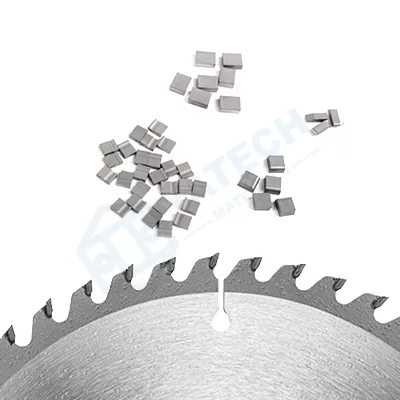
The economics rest on regrinding: carbide needs no heat treatment, so a blade can be reground repeatedly without losing hardness or stability — and with 5 to 20 times the edge life of tool steel, knife-change downtime drops by an order of magnitude. Add lower burr scrap, and cost per tonne slit favors carbide even though the blade costs several times more. YATECH also supplies other carbide cutting-edge products, such as tungsten carbide saw tips и carbide insert blanks, under the same quality system.
Get Carbide Slitter Blades Engineered for Your Line
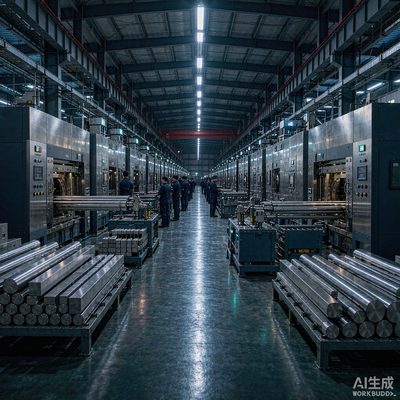
YATECH MATERIALS controls the full production chain — from tungsten powder through pressing, sintering and precision grinding — and ships a batch datasheet with every lot. There is no fixed minimum order quantity, samples are welcome, standard items ship in 7–15 days, and custom OD, ID, thickness and flatness are produced to your drawing (PDF, DWG or STEP) with an engineer’s grade recommendation and a reply within 24 hours.
If burr scrap, short knife life or frequent knife changes are limiting your slitting line, свяжитесь с нашей технической командой with your strip material, thickness and line speed — we will recommend the right grade and provide a tailored quotation.