
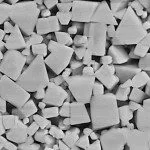
Какова марка цементированного карбида?
Карбид вольфрама (WC+Co+другое), также называемый цементированным карбидом, представляет собой композитный материал, изготавливаемый методом порошковой металлургии.
WC powder, generally 70–97% of the total weight, is mixed with a binder metal, usually cobalt or nickel and other carbides such as titanium carbide, tantalum carbide, niobium carbide, chromium carbide, etc.
The ready-to-press (RTP) powder — карбид вольфрама, cobalt, nickel and other carbide powders — is compacted in a die and then sintered in a HIP furnace.
Binderless tungsten carbide grades are also available
Typical applications: optical lens pressing molds, waterjet nozzles, highly wear-resistant bearings, and more.
Процесс производства карбида вольфрама
WC + Co/Ni + другие твердые сплавы Взвешивание ингредиентов → Измельчение (мокрое измельчение для получения смеси) → Распылительная сушка (вакуумная сушка) → Испытание на смешивание → Уплотнение (холодное изостатическое прессование CIP) → Мягкая обработка → Спекание (HIP 1450ºC) → Обработка (шлифование, EDM) → Обработка в мороз (-196°C) → Контроль качества
| Промышленность | ISO класс | Марка | Биндер 1ТП3Т | Размер зерна мкм | Плотность г/см^3 | Твердость HRA | TRS (МПа) | Приложение |
|---|---|---|---|---|---|---|---|---|
| Твердосплавные стержни (концевые фрезы) | К20-К40 | Ю20 | 10% | 0.7 | 14.45 | 91.8 | 3800 | Мелкий размер зерна, обработка на средней скорости, хорошие общие характеристики, рекомендуется сверло и концевые фрезы, подходящие для резки обычной легированной стали, алюминиевого сплава, жаропрочных сплавов, чугуна и т. д. |
| К05-К10 | Ю092 | 9% | 0.2 | 14.44 | 94.0 | 4100 | …for finishing hardened materials (above HRC 58) and producing high-gloss surface finishes on stainless steel, aluminum alloy and so on. | |
| К20-К40 | Ю25УФ | 12% | 0.4 | 14.10 | 92.6 | 4200 | Подходит для фрезерования нержавеющей стали, цветных металлов, титановых сплавов, жаропрочных сплавов и материалов высокой твердости (HRC50-58). Изнашиваемые детали | |
| К05-К10 | Ю10УФ | 6% | 0.4 | 14.80 | 94.0 | 3800 | Suitable for high hardened materials and finish-machining of composite material; also application for PCB tools and gravers. | |
| Carbide EDM Block, Plate (Stamping Dies) | - | YF40H | 12.5% | 1.0-2.0 | 14.20 | 89.5 | 3700 | Silicon Steel Sheet High-Speed Штамповочные штампыИмеет высокую стойкость к истиранию и ударную вязкость, а также высокую твердость. В основном он используется для производства обычного железного сердечника ротора двигателя серии Y. |
| - | YF50H | 14% | 1.5-3.0 | 14.00 | 88.5 | 3800 | Silicon Steel Sheet High-Speed Stamping Tools. With good toughness and shock resistance, it is suitable for producing complex iron cores of brushless motor and servo motor rotors. Mini-size iron core of motor rotor. | |
| - | Я20 | 13.5% | 0.5-1.5 | 14.50 | 90.0 | 3700 | Copper Alloys, Stainless steel,Pure Copper / Pure Iron Штамповочные штампыИмеет хорошие универсальные характеристики и прочность, используется для штамповки тонких пластин из нержавеющей стали и медных пластин. | |
| - | Я30 | 12% | 1.0-2.0 | 14.17 | 91.2 | 3600 | Copper Alloys, Stainless steel,Pure Copper / Pure Iron high speed precision Stamping tools. Middle cobalt and fine grain size hard material. High wear resistance and good edge-chipping resistance. Good electrical machining performance. Suitable for high stamping ≤0.2mm stainless steel полоска, Никелевый сплав полоска и медный сплав полоска. | |
| Износостойкие детали из карбида вольфрама | - | YF06N | 61ТП3Т Ни | 1.5 | 15.0 | 92.5 | 2050 | Превосходная износостойкость и устойчивость к коррозии, подходит для погружных масляных насосов, кислотостойких насосов, уплотнительных колец и шариков клапанов. |
| К10 | YG6 | 6% | 1.5 | 15.50 | 92.5 | 2720 | Applicable to low mechanical stress applications such as saw tips, nozzles and non-standard components. | |
| К20 | YG8 | 8% | 1.5 | 14.70 | 90.0 | 2900 | Good wear resistance, high strength, suitable for making non-standard structure and mechanic components under working conditions of normal stress. Saw tips, Изнашиваемые детали, Тарелки | |
| К40 | YG15 | 15% | 1.5 | 14.05 | 87.0 | 2700 | Хорошая прочность и ударная вязкость, подходят для изготовления нестандартных конструкций и механических компонентов в условиях больших напряжений. | |
| G40 | YG20 | 20% | 1.5 | 13.60 | 85.0 | 2500 | Ударопрочность, хорошая прочность. Подходит для изготовления штамповка умирает, штамповка умирает для аккумуляторных матриц, винтов, матриц для холодной высадки гаек и т. д. | |
| Carbide Roll Rings (Steel Industry) | - | ЮГР20 | 10.5% | 3.0 | 14.50 | 84.0 | 2400 | 13–14: finishing rolling; 17–18: reducing/sizing mill |
| - | ЮГР30 | 15% Ко+Ох | 3.0 | 14.00 | 84.5 | 2350 | 10-12 Чистовая прокатка | |
| - | ЮГР40 | 18% Ко+Ох | 3.0 | 13.70 | 83.0 | 2200 | 8-9 Чистовая прокатка | |
| - | ЮГР45 | 20% Ко+Ох | 3.2 | 13.60 | 82.0 | 2150 | 5-7 Чистовая прокатка | |
| - | ЮГР55 | 25% Ко+Другой | 3.2 | 13.10 | 79.5 | 2100 | Pre-Finishing Mill 1-4 passes | |
| - | ЮГР60 | 30% Ко+Ох | 3.5 | 12.65 | 77.5 | 2000 | Intermediate Mill Threaded Steel Bars (Rebar) | |
| Твердые сплавы для горной промышленности | - | YK06 | 6% | Отлично | 14.95 | 90.0 | 2600 | Отличная износостойкость и прочность. Подходит для погружных долот различных размеров. Может использоваться на горных породах средней твердости. |
| - | YK10 | 10% | Середина | 14.50 | 88.0 | 2850 | For cone bits and reamer bits of various sizes; suitable for medium-hard rock formations. | |
| - | YK11 | 11% | Середина | 14.40 | 87.7 | 2900 | Suitable for large-diameter cone bits and reamer bits; for medium-hard rock formations. | |
| Твердосплавная матрица для холодной высадки/Твердосплавные инструменты для формовки | - | CG5 | 12% | Середина | 14.3 | 88.3 | 3300 | Высокопрочные штампы для холодной высадки |
| - | CG6 | 14% | Середина | 14.12 | 87.3 | 3140 | Высокопрочные штампы для холодной высадки | |
| - | CA18 | 18% | Грубый | 13.75 | 85.1 | 2940 | Screw mold with bore below Ø20 | |
| - | CA24 | 24% | Грубый | 13.25 | 82.5 | 2650 | Винтовая форма Φ20 - Φ50 | |
| - | CT15 | 5% | Грубый | 13.8 | 86 | 2700 | Stainless steel screw die with bore below <Φ2 | |
| - | СТ20 | 20% | Грубый | 13.6 | 84.5 | 2660 | Stainless steel screw die with bore above >Ø2 | |
| - | СА20 | 20% | Грубый | 13.55 | 84.1 | 2740 | Штампы для теплой/горячей ковки | |
| без переплета | - | YC55 | 0% | 0.1 | 15.2 | 2700 | 1500 | Заготовки и преформы, сопла, формы для оптики |
| - | YC25 | 0% | 0.1 | 14.3 | 2400 | 2000 |
О компании Grade Development
We have extensive experience in material development, advanced material development equipment and material application engineers from various fields.
We can solve virtually any cemented carbide grade challenge.
ЭДМ Блоск, Рулон, Кольцо, Формирующий инструмент, Инструменты для штампов, Советы по пиле, Изнашиваемые детали, и т. д.
The Two Levers Behind Every Grade: Grain Size and Binder
Every grade in the table above is defined by two numbers. Grain size trades hardness against toughness: fine and ultra-fine grains (0.2-1.0 µm) maximize hardness, compressive strength and edge sharpness, while coarse grains (2.5-5 µm) absorb impact through thicker binder layers. Binder content tunes the same balance: cobalt from 6-8% favors hardness and erosion resistance, 9-12% is the balanced middle ground, and 13-30% is specified when impact and breakage resistance matter more than wear.
A simple mental model: abrasive wear attacks the surface grain by grain, so small hard grains resist it best. Impact damage travels through micro-cracks, which large grains and more binder interrupt and absorb. Identifying which mechanism dominates your application is the first step of grade selection.
Match the Grade to the Wear Mechanism
- Abrasion (sand, ore, sliding particles): fine-to-medium grain, 6-12% Co, hardness first.
- Impact (crushing, milling picks, misfed stamping): coarser grain, 12-20% Co, toughness first.
- Эрозия (waterjet, slurry, blast nozzles): fine grain with low binder, or nano/binderless grades when corrosion accompanies erosion.
- Metal-to-metal sliding (drawing, rolling, forming): fine-medium grain, polished surface, 10-12% Co.
Typical Applications and Recommended Grade Families
Grade families reference the YATECH grades listed in the table above; our engineers tailor the final grade to your working conditions.
| Приложение | Recommended grade family | What you get |
|---|---|---|
| Metal cutting (milling, turning, drilling) | Sub-micron 0.2-0.7 µm, 9-12% Co — YU092 / YU20 / YU25UF | 91.8-94.0 HRA, TRS up to 4200 MPa — sharp, heat-resistant edges |
| Wood cutting saw tips | Medium grain ~1.5 µm, 6-8% Co — YG6 / YG8 | 90.0-92.5 HRA — balanced sharpness and shock resistance |
| Mining tools (DTH bits, cone bits) | Fine-medium grain, 6-11% Co — YK06 / YK10 / YK11 | 87.7-90.0 HRA — combined impact + abrasion life |
| Crusher parts, jaw plates | Dual-scale medium + coarse grain, 15-20% Co — YG15 / YG20 | Chipping-resistant teeth under heavy shock |
| Erosion: nozzles, waterjet, slurry | Fine grain with ≤6% binder — YG6; or binderless YC2 / YC5 | 92.5+ HRA, no binder phase in YC grades — maximum erosion life |
| Corrosive service (pumps, seals, valves) | 6% Ni binder YF06N, or binderless WC — YC2 / YC5 | No cobalt phase to corrode — seal rings, valve balls, acid pumps |
| Штамповочные штампы, EDM blocks | Fine-medium 0.5-3.0 µm, 12-14% Co — YA20 / YA30 / YF40H / YF50H | 88.5-91.2 HRA — stable EDM cutting, long punch life |
| Cold heading dies, screw & forging tools | Medium-coarse grain, 12-24% Co — CG5 / CG6 / CA18 / CA24 / CT15 / CT20 (CA20 for warm/hot forging) | 85.1-88.3 HRA — high toughness, low die breakage |
| Wire drawing dies & roll rings | Drawing nibs: fine-medium grain, polished; roll rings: coarse 3.0-3.5 µm, 10.5-30% Co — YGR20 to YGR60 by mill stand | Low galling; thermal-crack and groove-wear resistant |
A Five-Step Selection Framework
- Rank the failure mode — abrasion, impact, erosion or metal pickup? A worn surface tells you: polished = abrasion, chipped = impact, flow grooves = erosion.
- Score hardness vs. toughness demand (1-5 each) — high hardness wins: fine grain, low binder; high toughness wins: coarse grain, more cobalt; both high: sub-micron with 10-12% Co.
- Add temperature — above ~500 °C consider TaC/NbC additions or fine grain with controlled binder to resist thermal softening.
- Add corrosion — acidic or saline media attack cobalt binder first; nickel binder or binderless grades are the answer.
- Validate with datasheets — compare density, hardness, TRS and porosity class, and confirm the sintering route (HIP-processed material shows measurably fewer defects).
For a deeper walkthrough with worked examples, read our guide How to Choose Tungsten Carbide Grades for Wear Parts.
Three Mistakes That Shorten Carbide Life
- Specifying hardness alone — a 94 HRA grade can fracture on day three in a rock crusher. Always read hardness together with TRS.
- Over-adding cobalt as a safety margin — excess binder often doubles wear rate while solving a fracture problem that better process control could have prevented.
- Ignoring the sintering route — the same nominal grade can differ by 2 HRA and 500 MPa TRS between vacuum and HIP sintering.
Beyond Standard WC-Co
For corrosive slurry nozzles and mirror-finish components, our бессвязочный карбид вольфрама grades reach 93-94 HRA with no binder phase to corrode. For combined wear and impact duty, sub-micron grades deliver 93+ HRA with TRS above 3000 MPa — properties that were mutually exclusive a decade ago. For chemical and downhole environments, nickel-binder grades replace cobalt where corrosion resistance is mandatory.
Frequently Asked Questions
How do I choose the right tungsten carbide grade?
Start from the failure mode: abrasion calls for fine grain and lower binder (hardness first), impact calls for coarser grain and higher cobalt (toughness first), and mixed duty uses sub-micron or fine grain with 10-12% Co. Then confirm temperature and corrosion conditions. Send us your working conditions and our engineers will recommend a grade with typical property values within 24 hours.
What is the difference between fine, medium and coarse grain carbide?
Fine and ultra-fine grains (0.2-1.0 µm) give the highest hardness and edge sharpness but lower toughness. Medium grains (1.0-2.5 µm) balance wear and strength. Coarse grains (2.5-5 µm) absorb impact best at the cost of hardness. Grain size mainly trades hardness against toughness.
What does cobalt content change?
Cobalt is the ductile binder between carbide grains. More cobalt (up to about 20%) means higher transverse rupture strength and impact resistance but slightly lower hardness. Low-cobalt grades (3-8%) suit erosion and finishing; high-cobalt grades (12-25%) suit crushing, stamping and heavy forming.
Can you produce custom grades or tailor an existing one?
Yes. Besides the standard grades in the table, we adjust grain size, binder content and additives (TaC/NbC/CrC, Ni binder, binderless) to the application, sintered in HIP furnaces with certified density and hardness data per batch. Sampling typically takes 7-15 days.
Do you supply datasheets and certificates with shipments?
Every batch ships with certified typical values: density, hardness (HRA/HV), TRS and magnetic saturation on request, so incoming quality can be verified against the agreed specification.
Not Sure Which Grade Fits? Ask Our Engineers
Send the working conditions (material, impact level, temperature, media) or your drawing — we reply with a grade recommendation and quote within 24 hours.