Waterjet cutting occupies a unique position in modern fabrication: it can cut virtually any material — hardened steel, titanium, stone, glass, rubber, carbon fiber — with no heat-affected zone and no mechanical distortion. But every waterjet system depends on one small consumable that concentrates 60,000 psi (about 4,100 bar) of pressurized water and garnet abrasive into a jet narrower than a millimeter: the focusing nozzle. When this component wears, kerf width drifts, edge quality degrades and cutting speed drops within hours. That is why premium waterjet focusing tubes are manufactured from tungsten carbide waterjet nozzles, and why nozzle material selection has a direct, measurable impact on the cost of every meter cut.
In this article, we explain how the carbide waterjet nozzle works inside the cutting head, why tungsten carbide outperforms alternative materials, and how to specify and maintain nozzles for maximum cutting productivity.
Why the Focusing Nozzle Is the Heart of a Waterjet Cutting System
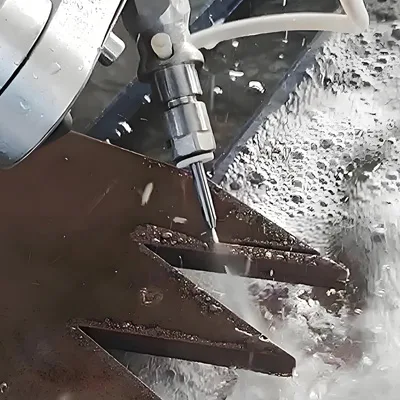
A pure waterjet can slice soft materials on its own, but for metal, stone or composites, the cutting head mixes garnet abrasive into the stream. Inside the mixing chamber, the high-velocity water jet leaving the sapphire or diamond orifice creates a partial vacuum that draws abrasive into the flow, and the carbide focusing tube then accelerates and collimates this three-phase jet (water, air, garnet) into a coherent cutting beam.
The working conditions inside that tube are extreme:
- Velocities approaching three times the speed of sound, with garnet particles striking the bore wall millions of times per hour.
- Abrasive concentrations of 5–15% by weight, turning the bore into a continuous micro-erosion environment.
- Repeated pressure cycling from 0 to 4,100 bar every time the machine starts and stops a cut.
- Vibration and clamping stress transmitted through the nozzle holder during rapid traverse movements.
No material survives this combination by accident. The focusing tube is deliberately the shortest-lived consumable in the cutting head — typically replaced after 40 to 100 hours of jet-on time — but how long it actually lasts depends almost entirely on the quality of its tungsten carbide.
Why Tungsten Carbide Is the Material of Choice for Waterjet Nozzles
Waterjet nozzle materials have evolved through several generations, and each alternative fails for a different reason:
- Tool steels: Eroded through in minutes. Not viable for abrasive suspension jets.
- Ceramics (alumina, zirconia): Reasonably hard but brittle; chipping under pressure spikes and mechanical shock limits life.
- Sapphire and diamond: Excellent for the tiny upstream orifice insert, but impractical and uneconomical for 60–100 mm focusing tubes.
- Tungsten carbide (WC-Co): The only practical balance of hardness, toughness and manufacturability for the focusing tube itself.
Cemented carbide combines WC grains — close to diamond in hardness — with a ductile cobalt binder that absorbs micro-impact without cracking. For waterjet service specifically, carbide provides:
- Hardness typically HRA 89–93, several times more wear-resistant than any steel.
- High compressive strength to withstand 4,100 bar internal pressure without deformation.
- Uniform, fine microstructure that erodes evenly instead of grain-by-grain, keeping the jet stream stable over the tube’s full life.
- Good thermal conductivity, which dissipates heat generated by abrasive friction at the bore wall.
The same material logic applies across the cutting and tooling industries — it is the reason carbide also dominates wear applications such as Verschleißteile aus Wolframcarbid and general-purpose carbide nozzles for sandblasting, spraying and fluid handling.
Where Carbide Waterjet Nozzles Deliver the Most Value
Nozzle consumption scales directly with cutting hours, so carbide waterjet nozzles matter most in high-utilization, quality-critical operations:
- Job-shop metal fabrication: Cutting stainless, aluminum and wear plate where edge quality sells the job. A worn nozzle widens the kerf and roughens the pierce zone, forcing slower feed rates or rework.
- Stone, tile and glass processing: Intricate inlay and cutout work demands a coherent jet; a drifting stream destroys fragile edges on expensive material.
- Aerospace and composites: Carbon fiber and titanium laminates tolerate no delamination or heat damage, and narrow, stable kerfs minimize expensive material waste.
- Thick-section cutting: Steel above 50 mm requires maximum jet coherence; nozzle wear shows up immediately as a stepped, angled cut face.
- Waterjet maintenance providers: Distributors and service centers stocking nozzles benefit from consistent bore geometry, because predictable wear lets them define honest replacement intervals for end customers.
Across all of these applications, the pattern is identical: cutting-machine uptime, edge quality and abrasive consumption all trace back to the condition of one small carbide component.
How to Select the Right Carbide Waterjet Nozzle
Choosing a focusing tube is more than matching a part number. Three parameters dominate performance:
Bore Diameter and Length
Common mixing tube bores range from 0.76 mm to 1.27 mm (0.030″–0.050″), paired with an orifice roughly one third of the bore size. Narrower bores produce finer, more precise kerfs at slower speeds; wider bores cut faster and tolerate coarser abrasive but consume more garnet per meter. Length — typically 76 mm or 101 mm — must match the cutting head’s mixing chamber geometry, because jet coherence develops along the tube’s exit section. Always replace the focusing tube and check orifice condition together: a chipped sapphire orifice will destroy a fresh carbide nozzle within hours.
Carbide Grade and Manufacturing Quality
Within the WC-Co system, fine grain sizes with cobalt content in the 6–15% range are typical for waterjet nozzles, balancing erosion resistance against fracture toughness. Equally important is how the blank is made:
- Density and porosity control: Pressure-assisted sintering eliminates the pores that become nucleation sites for abrasive erosion.
- Concentricity and bore finish: A polished, concentric bore keeps the jet centered, preventing one-sided wear that distorts the cut angle.
- Consistent hardness batch to batch: Predictable wear behavior is what allows scheduled replacement instead of surprise failures mid-job.
YATECH manufactures tungsten carbide from raw powder through pressing, sinter-HIP and precision grinding, which is why our waterjet nozzle range maintains tight bore tolerances and consistent grade quality across production lots — the properties that machine operators actually feel in day-to-day cutting.
Recognizing Nozzle Wear Before It Costs You
Focusing tubes rarely fail suddenly; they degrade in ways that are easy to miss until quality complaints appear. Train operators to watch for:
- Widening kerf and increasing taper: The most reliable early indicator — measure kerf width at a standard test speed.
- Rougher pierce zones and lag lines: As the jet loses coherence, the exit side of the cut lags further behind the entry side.
- Falling cutting speed: Compensating for a worn nozzle by slowing the feed rate silently inflates cycle time and cost per part.
- Visible bell-mouthing at the tube exit: Under magnification, an eroded exit orifice confirms the jet has been dispersing for some time.
A practical best practice: log jet-on hours, replace focusing tubes on a fixed interval matched to your abrasive quality and feed rates, and keep one spare loaded nozzle per cutting head so replacement is a five-minute changeover, not a production stop.
Working With a Waterjet Nozzle Manufacturer
Because the focusing tube is a high-frequency consumable, the right supplier relationship is built on consistency and responsiveness rather than a one-time purchase. YATECH MATERIALS supplies standard and custom-dimension carbide waterjet nozzles, supports bore and length configurations matched to major cutting-head platforms, and manufactures adjacent fluid-handling components — from blasting to high-pressure spray — in the same grade family, so one supplier can cover multiple nozzle needs in your plant.
If you are standardizing nozzle consumables across a waterjet cutting operation, or evaluating carbide grades for longer replacement intervals, contact the YATECH technical team with your cutting-head model, material mix and current nozzle consumption — we will recommend a specification and provide a quotation.