
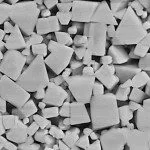
Welche Qualität hat Hartmetall?
Wolframcarbid (WC+Co+Sonstiges), auch als Hartmetall bezeichnet, ist ein Verbundwerkstoff, der durch ein Verfahren namens Pulvermetallurgie hergestellt wird.
WC powder, generally 70–97% of the total weight, is mixed with a binder metal, usually cobalt or nickel and other carbides such as titanium carbide, tantalum carbide, niobium carbide, chromium carbide, etc.
The ready-to-press (RTP) powder — Wolframcarbid, cobalt, nickel and other carbide powders — is compacted in a die and then sintered in a HIP furnace.
Binderless tungsten carbide grades are also available
Typical applications: optical lens pressing molds, waterjet nozzles, highly wear-resistant bearings, and more.
Hartmetall-Produktionsprozess
WC + Co/Ni + anderes Karbid Einwiegen der Bestandteile → Mahlen (Mischung durch Nassmahlen herstellen) → Sprühtrocknung (Vakuumtrocknung) → Mischungstest → Verdichtung (CIP Kaltisostatisches Pressen) → Weichbearbeitung → Sintern (HIP 1450 °C) → Bearbeitung (Schleifen, Erodieren) → Minustemperaturbehandlung (-196 °C) → Qualitätskontrolle
| Industrie | ISO-Klasse | Grad | Bindemittel % | Korngröße μm | Dichte g/cm^3 | Härte HRA | TRS (MPa) | Anwendung |
|---|---|---|---|---|---|---|---|---|
| Hartmetallstäbe (Hartmetall-Schaftfräser) | K20-K40 | YU20 | 10% | 0.7 | 14.45 | 91.8 | 3800 | Subfeine Korngröße, Bearbeitung bei mittlerer Geschwindigkeit, gute allgemeine Leistung, Bohrer und Schaftfräser werden empfohlen, geeignet zum Schneiden von gewöhnlichem legiertem Stahl, Aluminiumlegierung, hitzebeständiger Legierung, Gusseisen usw. |
| K05-K10 | YU092 | 9% | 0.2 | 14.44 | 94.0 | 4100 | Spezielle ultrafeine Hartmetallsorte zum Schlichten hochgehärteter Materialien (über HRC58), zur Hochlichtoberflächenbehandlung von rostfreiem Stahl, Aluminiumlegierungen usw. | |
| K20-K40 | YU25UF | 12% | 0.4 | 14.10 | 92.6 | 4200 | Geeignet zum Fräsen von Edelstahl, Nichteisenmetallen, Titanlegierungen, Hochtemperaturlegierungen und hochharten Materialien (HRC50-58). Verschleißteile | |
| K05-K10 | YU10UF | 6% | 0.4 | 14.80 | 94.0 | 3800 | Geeignet für stark gehärtete Materialien und die Endbearbeitung von Kompostmaterial; auch für PCB-Werkzeuge und Stichel geeignet. | |
| Hartmetall-EDM-Block, Platte (Stanzwerkzeuge) | - | YF40H | 12.5% | 1.0-2.0 | 14.20 | 89.5 | 3700 | Silicon Steel Sheet High-Speed StanzformenHat eine hohe Abriebfestigkeit und Zähigkeit sowie eine hohe Härte. Es wird hauptsächlich zur Herstellung herkömmlicher Eisenkerne der Y-Serie von Motorrotoren verwendet. |
| - | YF50H | 14% | 1.5-3.0 | 14.00 | 88.5 | 3800 | Silicon Steel Sheet High-Speed Stamping Tools. With good toughness and shock resistance, it is suitable for producing complex iron cores of brushless motor and servo motor rotors. Mini-size iron core of motor rotor. | |
| - | YA20 | 13.5% | 0.5-1.5 | 14.50 | 90.0 | 3700 | Legierungskupfer, Edelstahl, reines Kupfer, reines Eisen PrägestempelHat eine gute universelle Leistung und Zähigkeit und wird zum Stanzen dünner Edelstahlplatten und Kupferplatten verwendet. | |
| - | YA30 | 12% | 1.0-2.0 | 14.17 | 91.2 | 3600 | Alloy Copper, Stainless steel,Pure Copper Pure Iron high speed precision Stamping tools. Middle cobalt and fine grain size hard material. High wear resistance and good edge-chipping resistance. Good electrical machining performance. Suitable for high stamping ≤0.2mm stainless steel Streifen, Nickel-Legierung Streifen und Kupferlegierung Streifen. | |
| Hartmetall-Verschleißteile | - | YF06N | 6% Ni | 1.5 | 15.0 | 92.5 | 2050 | Hervorragende Verschleiß- und Korrosionsbeständigkeit, geeignet für Tauchölpumpen, säurebeständige Pumpen, Dichtungsringe und Ventilkugeln. |
| K10 | YG6 | 6% | 1.5 | 15.50 | 92.5 | 2720 | Applicable to low mechanical stress applications such as saw tips, nozzles and non-standard components. | |
| K20 | YG8 | 8% | 1.5 | 14.70 | 90.0 | 2900 | Good wear resistance, high strength, suitable for making non-standard structure and mechanic components under working conditions of normal stress. Saw tips, Verschleißteile, Platten | |
| K40 | YG15 | 15% | 1.5 | 14.05 | 87.0 | 2700 | Gute Festigkeit und Schlagzähigkeit, geeignet für die Herstellung nicht standardmäßiger Strukturen und mechanischer Komponenten unter Arbeitsbedingungen mit großer Belastung. | |
| G40 | YG20 | 20% | 1.5 | 13.60 | 85.0 | 2500 | Schlagfestigkeit, gute Zähigkeit. Zur Herstellung geeignet Stanzformen, Stanzformen für Batteriegehäusebacken, Schrauben, Kaltstauchbacken für Muttern usw. | |
| Hartmetall-Rollenring (Stahlindustrie) | - | YGR20 | 10.5% | 3.0 | 14.50 | 84.0 | 2400 | 13-14 Fertigwalzen 17-18 Reduzier-/Kalibrierwalzwerk |
| - | YGR30 | 15% Co+Andere | 3.0 | 14.00 | 84.5 | 2350 | 10-12 Fertigwalzen | |
| - | YGR40 | 18% Co+Andere | 3.0 | 13.70 | 83.0 | 2200 | 8-9 Fertigwalzen | |
| - | YGR45 | 20% Co+Andere | 3.2 | 13.60 | 82.0 | 2150 | 5-7 Fertigwalzen | |
| - | YGR55 | 25% Co+Andere | 3.2 | 13.10 | 79.5 | 2100 | Pre-Finishing Mill 1-4 passes | |
| - | YGR60 | 30% Co+Andere | 3.5 | 12.65 | 77.5 | 2000 | Intermediate Mill Threaded Steel Bars (Rebar) | |
| Hartmetall-Bergbauwerkzeuge | - | YK06 | 6% | Bußgeld | 14.95 | 90.0 | 2600 | Hervorragende Verschleißfestigkeit und Zähigkeit, geeignet für DTH-Bits verschiedener Größen. Kann auf mittelharten Felsformationen eingesetzt werden. |
| - | YK10 | 10% | Mittel | 14.50 | 88.0 | 2850 | Die Verschleißfestigkeit für Kegelmeißel und Reibahlenmeißel verschiedener Größen kann auf mittelharten Felsformationen eingesetzt werden. | |
| - | YK11 | 11% | Mittel | 14.40 | 87.7 | 2900 | Geeignet für große Kegel- und Reibbohrer. Kann in mittelharten Felsformationen verwendet werden. | |
| Hartmetall-Kaltstauchmatrize/Karbid-Umformwerkzeuge | - | CG5 | 12% | Mittel | 14.3 | 88.3 | 3300 | Kaltstauchwerkzeuge mit hoher Zähigkeit |
| - | CG6 | 14% | Mittel | 14.12 | 87.3 | 3140 | Kaltstauchwerkzeuge mit hoher Zähigkeit | |
| - | CA18 | 18% | Grob | 13.75 | 85.1 | 2940 | Screw mold with bore below Φ20 | |
| - | CA24 | 24% | Grob | 13.25 | 82.5 | 2650 | Screw mold Φ20 - Φ50 | |
| - | CT15 | 5% | Grob | 13.8 | 86 | 2700 | Stainless steel screw die with bore below <Φ2 | |
| - | CT20 | 20% | Grob | 13.6 | 84.5 | 2660 | Stainless steel screw die with bore above >Φ2 | |
| - | CA20 | 20% | Grob | 13.55 | 84.1 | 2740 | Warm-/Warmschmiedegesenke | |
| Ohne Bindemittel | - | YC55 | 0% | 0.1 | 15.2 | 2700 | 1500 | Rohlinge und Vorformen, Düsen, Optikformen |
| - | YC25 | 0% | 0.1 | 14.3 | 2400 | 2000 |
Über die Notenentwicklung
We have extensive experience in material development, advanced material development equipment and material application engineers from various fields.
We can solve virtually any cemented carbide grade challenge.
EDM Block, Rollen, Ring, Formwerkzeug, Stanzwerkzeuge, Sägespitzen, Verschleißteile, usw.
The Two Levers Behind Every Grade: Grain Size and Binder
Every grade in the table above is defined by two numbers. Grain size trades hardness against toughness: fine and ultra-fine grains (0.2-1.0 µm) maximize hardness, compressive strength and edge sharpness, while coarse grains (2.5-5 µm) absorb impact through thicker binder layers. Binder content tunes the same balance: cobalt from 3-8% favors hardness and erosion resistance, 9-12% is the balanced middle ground, and 13-25% is specified when impact and breakage resistance matter more than wear.
A simple mental model: abrasive wear attacks the surface grain by grain, so small hard grains resist it best. Impact damage travels through micro-cracks, which large grains and more binder interrupt and absorb. Identifying which mechanism dominates your application is the first step of grade selection.
Match the Grade to the Wear Mechanism
- Abrasion (sand, ore, sliding particles): fine-to-medium grain, 8-12% Co, hardness first.
- Impact (crushing, milling picks, misfed stamping): coarser grain, 12-16% Co, toughness first.
- Erosion (waterjet, slurry, blast nozzles): fine grain with low binder, or nano/binderless grades when corrosion accompanies erosion.
- Metal-to-metal sliding (drawing, rolling, forming): fine-medium grain, polished surface, 10-12% Co.
Typical Applications and Recommended Grade Families
Typical values based on common industry practice; our engineers tailor the final grade to your working conditions.
| Anwendung | Recommended grade family | What you get |
|---|---|---|
| Metal cutting (milling, turning, drilling) | Sub-micron, 6-10% Co | 92-94.5 HRA — sharp, heat-resistant edges |
| Wood cutting saw tips | Fine-medium, 6-12% Co | Balanced sharpness and shock resistance |
| Mining tools, road milling picks | Sub-micron/medium, 10-12% Co | Combined impact + abrasion life |
| Crusher parts, jaw plates | Coarse grain, 12-15% Co | Chipping-resistant under heavy shock |
| Erosion: nozzles, waterjet, slurry | Fine grain, 3-8% Co (or nano) | 92-94 HRA, maximum erosion life |
| Corrosive service | Ni binder or binderless WC | No cobalt phase to corrode |
| Prägestempel, EDM blocks | Sub-micron/fine, 6-10% Co | Stable EDM cutting, long punch life |
| Wire drawing, rolls | Fine-medium, 10-12% Co, polished | Low galling, long groove life |
A Five-Step Selection Framework
- Rank the failure mode — abrasion, impact, erosion or metal pickup? A worn surface tells you: polished = abrasion, chipped = impact, flow grooves = erosion.
- Score hardness vs. toughness demand (1-5 each) — high hardness wins: fine grain, low binder; high toughness wins: coarse grain, more cobalt; both high: sub-micron with 10-12% Co.
- Add temperature — above ~500 °C consider TaC/NbC additions or fine grain with controlled binder to resist thermal softening.
- Add corrosion — acidic or saline media attack cobalt binder first; nickel binder or binderless grades are the answer.
- Validate with datasheets — compare density, hardness, TRS and porosity class, and confirm the sintering route (HIP-processed material shows measurably fewer defects).
For a deeper walkthrough with worked examples, read our guide How to Choose Tungsten Carbide Grades for Wear Parts.
Three Mistakes That Shorten Carbide Life
- Specifying hardness alone — a 94 HRA grade can fracture on day three in a rock crusher. Always read hardness together with TRS.
- Over-adding cobalt as a safety margin — excess binder often doubles wear rate while solving a fracture problem that better process control could have prevented.
- Ignoring the sintering route — the same nominal grade can differ by 2 HRA and 500 MPa TRS between vacuum and HIP sintering.
Beyond Standard WC-Co
For corrosive slurry nozzles and mirror-finish components, our bindemittelfreies Wolframcarbid grades reach 93-94 HRA with no binder phase to corrode. For combined wear and impact duty, sub-micron grades deliver 93+ HRA with TRS above 3000 MPa — properties that were mutually exclusive a decade ago. For chemical and downhole environments, nickel-binder grades replace cobalt where corrosion resistance is mandatory.
Frequently Asked Questions
How do I choose the right tungsten carbide grade?
Start from the failure mode: abrasion calls for fine grain and lower binder (hardness first), impact calls for coarser grain and higher cobalt (toughness first), and mixed duty uses sub-micron or fine grain with 10-12% Co. Then confirm temperature and corrosion conditions. Send us your working conditions and our engineers will recommend a grade with typical property values within 24 hours.
What is the difference between fine, medium and coarse grain carbide?
Fine and ultra-fine grains (0.2-1.0 µm) give the highest hardness and edge sharpness but lower toughness. Medium grains (1.0-2.5 µm) balance wear and strength. Coarse grains (2.5-5 µm) absorb impact best at the cost of hardness. Grain size mainly trades hardness against toughness.
What does cobalt content change?
Cobalt is the ductile binder between carbide grains. More cobalt (up to about 20%) means higher transverse rupture strength and impact resistance but slightly lower hardness. Low-cobalt grades (3-8%) suit erosion and finishing; high-cobalt grades (12-25%) suit crushing, stamping and heavy forming.
Can you produce custom grades or tailor an existing one?
Yes. Besides the standard grades in the table, we adjust grain size, binder content and additives (TaC/NbC/CrC, Ni binder, binderless) to the application, sintered in HIP furnaces with certified density and hardness data per batch. Sampling typically takes 7-15 days.
Do you supply datasheets and certificates with shipments?
Every batch ships with certified typical values: density, hardness (HRA/HV), TRS and magnetic saturation on request, so incoming quality can be verified against the agreed specification.
Not Sure Which Grade Fits? Ask Our Engineers
Send the working conditions (material, impact level, temperature, media) or your drawing — we reply with a grade recommendation and quote within 24 hours.