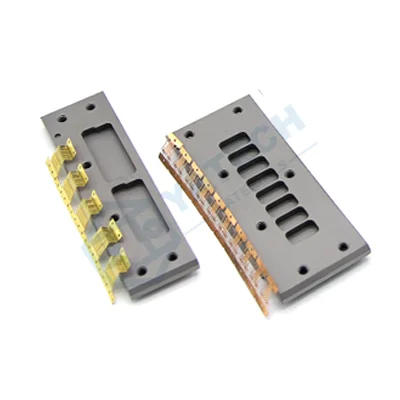
Precision stamping is one of the most demanding metalforming processes in modern manufacturing. Terminal connectors, lead frames, EMI shielding cans, motor laminations and countless electronic components are all produced at speeds of hundreds of strokes per minute — and every impact is absorbed by the die. As production volumes grow and material thicknesses shrink, tool steels increasingly fail to keep up. That is why more die makers are turning to tungsten carbide EDM blocks as the core material for high-wear die sections.
In this article, we explain why cemented carbide has become the material of choice for precision stamping dies, how EDM blocks fit into the die manufacturing workflow, and how to select the right carbide grade for your application.
Why Precision Stamping Dies Demand More Than Tool Steel
A progressive stamping die may perform millions of strokes before maintenance. Each stroke combines high contact stress, sliding friction against the strip material, and — with high-speed presses — significant thermal loading. Conventional D2 or M2 tool steels typically deliver 500,000 to 1,000,000 strokes between regrinds. Tungsten carbide, by comparison, can reach 10 to 50 million strokes under the same conditions.
The difference comes from the material itself. Cemented carbide combines tungsten carbide (WC) grains — among the hardest materials used in tooling — with a tough cobalt binder. This structure provides:
- Résistance à l'usure extrême : Hardness typically ranging from HRA 86 to 93, far beyond any tool steel.
- Outstanding compressive strength: Critical for cutting and forming edges that see repeated impact loading.
- Excellent elastic modulus: Approximately 600 GPa, roughly three times that of steel, which minimizes edge deflection and maintains tight tolerances.
- Thermal stability: Hardness is retained even as die temperatures rise during high-speed operation.
For a die maker, longer tool life translates directly into fewer die changes, less downtime and lower cost per thousand parts — decisive advantages in high-volume electronics and automotive stamping.
What Is a Tungsten Carbide EDM Block?
Most carbide stamping die inserts cannot be fully machined by conventional cutting or grinding because of carbide’s hardness. Instead, die makers rely on wire electrical discharge machining (wire EDM) to cut complex profiles — punching stations, forming radii, intricate detail work — directly into the carbide insert.
A bloc EDM en carbure de tungstène is a pre-sintered, ground blank supplied in standard sizes specifically prepared for this EDM process. Using a finished EDM block instead of cutting shapes from raw stock offers three key benefits:
- Dimensional stability: Quality EDM blocks are stress-relieved and ground on all six sides, so profiles cut into them stay within a few microns.
- Clean, low-recast surfaces: Premium blocks are formulated to minimize cobalt stripping and micro-cracking during discharge, producing smoother die openings that resist galling and material pickup.
- Reduced finishing time: Pre-ground blocks let die makers go straight to wire EDM, shortening die delivery lead times.
For readers interested in the manufacturing side, we previously covered why cold isostatically pressed (CIP) EDM blocks offer superior uniformity, and how to handle the common practical questions in EDM block use.
Where EDM Blocks Fit in a Progressive Stamping Die
In a typical carbide-equipped progressive die, EDM blocks become the working inserts at the most heavily loaded stations:
- Punch and die buttons for piercing, where edge wear and chipping control hole quality over millions of strokes.
- Cutting and blanking sections for the outside profile of terminals and lead frames.
- Forming and coining inserts where high contact stress would rapidly wear tool steel.
- Draw pads and guide components where sliding contact against the strip generates abrasive wear.
For complete die solutions, carbide EDM blocks are often combined with other tooling produced by YATECH — such as our tungsten carbide progressive stamping die components — to build an all-carbide high-wear package where it matters most.
How to Choose the Right Carbide Grade
Grade selection is the single most important engineering decision when specifying an EDM block. It is essentially a trade-off between wear resistance and toughness, controlled mainly by two parameters: grain size and cobalt content.
Taille d'un grain
- Sub-micron and ultra-fine grains (0.2–0.8 µm): High hardness and compressive strength, excellent for sharp-edged piercing in thin stainless and copper alloys. Recommended for micro-laminations and fine-blanking.
- Fine grains (0.8–1.3 µm): The most common choice for stamping EDM blocks — a balanced combination of wear resistance and edge stability.
- Medium grains (1.3–2.5 µm): Greater toughness for thicker, high-strength strip materials and forming stations.
Cobalt Content
- 6–8% Co: Standard for cutting and piercing applications requiring maximum hardness.
- 10–15% Co: Better impact resistance for forming, coining and heavy-duty progressive dies.
- Ni or Ni-Cr binders: Choose these when stamping in corrosive environments or when non-magnetic properties are required — see our non-magnetic tungsten carbide solutions.
A practical starting point: for stainless steel lead frames below 0.3 mm, begin with a 6% Co ultra-fine grade; for copper terminals and thicker stock, a 10–15% Co fine grade usually delivers the best total cost of ownership. Our tungsten carbide grades reference details the full range of standard compositions.
Common Failure Modes and How to Avoid Them
Even the best carbide will fail prematurely if the die system around it is wrong. Watch for these issues:
- Chipping from poor strip support: Ensure tight guidance of punches and adequate stripper pressure; carbide tolerates compression far better than side loading.
- Thermal cracking from EDM re-melt: Use finishing passes with lower discharge energy and proper cobalt-rich surface treatments to preserve edge integrity.
- Galling and material pickup: When stamping stainless or aluminum, consider finer grades with polished working surfaces or specialized binder chemistry.
- Misalignment: Because carbide inserts last so long, the die structure around them must be built to the same durability standard — otherwise alignment drift, not insert wear, becomes the limiting factor.
Working With a Carbide EDM Block Supplier
Consistency batch after batch is what separates a reliable EDM block supplier from a commodity seller. At YATECH MATERIALS, we control the full production chain — from tungsten powder through spray drying, CIP pressing, sintering and precision grinding — and supply EDM blocks in standard and custom dimensions with tight flatness and perpendicularity tolerances. Our engineers also help die makers select grades matched to their strip material, thickness and press speed.
If you are upgrading a progressive die from tool steel to carbide, or troubleshooting insert life in a high-speed stamping line, contact our technical team for a tailored material recommendation and quotation.