Wire drawing is one of the oldest metalforming processes in existence — and still one of the most demanding. Every kilometer of tire cord, magnet wire, welding wire, PC strand or fine stainless wire is pulled through a die that must hold its geometry micron after micron, kilometer after kilometer. As drawing speeds rise and downstream customers tighten tolerances, the die itself has become the component that decides line productivity. That is why manufacturers worldwide now specify tungsten carbide drawing dies as the standard working material for both ferrous and non-ferrous drawing operations.
In this guide, we explain why carbide outperforms other die materials, how a drawing die is engineered, how to select the right grade and nib size for your wire, and where modern diamond coatings extend die life even further.
Why Ordinary Die Materials Fail in Wire Drawing
During drawing, the die bore is subjected to a punishing combination of loads at the same time. Contact pressures in the deformation zone can exceed 1,500 MPa — several times the yield strength of most die steels. Sliding friction against the wire surface generates heat; abrasive scale, dust and worn lubricant act like a grinding paste; and every coil change introduces impact loading at the entrance. Gray cast iron and tool steel nibs simply cannot survive this environment for long — in demanding applications their lives are measured in hours.
Cemented carbide — hard tungsten carbide (WC) grains bonded in a tough cobalt matrix — offers a property profile that no steel can match:
- Hardness of HRA 88–93: far above any hardened tool steel, so the bore resists abrasive wear from scale and contaminated lubricant.
- Compressive strength above 3,000 MPa and elastic modulus around 600 GPa: the die bore resists plastic deformation and keeps its geometry stable under peak drawing loads.
- Outstanding polishability: carbide can be polished to a mirror finish, reducing friction, wire breakage and surface defects on the drawn product.
- High thermal conductivity: drawing heat is dissipated quickly through the nib and casing instead of concentrating in the reduction zone.
The practical result is dramatic: a carbide drawing die typically lasts 10 to 100 times longer than a gray iron or tool steel die in the same application, while holding wire diameter far more consistently over its life.
Anatomy of a Tungsten Carbide Drawing Die
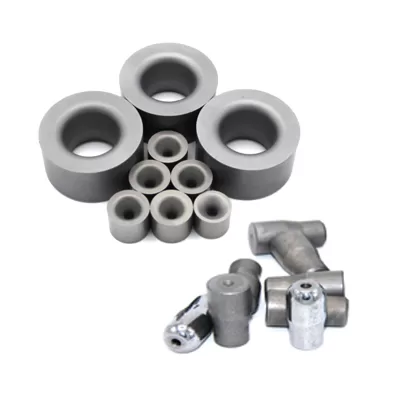
A complete drawing die consists of two parts: a sintered carbide nib that does the actual work, and a steel casing that provides compressive support so the hard, but relatively brittle, carbide can withstand the drawing force. The nib’s internal profile is engineered as four consecutive zones:
- Entrance cone: centers the incoming wire and holds lubricant so it is carried into the deformation zone.
- Reduction zone: where plastic deformation actually happens. The reduction angle — typically 8–16° for steel wire and wider for soft non-ferrous metals — controls drawing force, die pressure and lubricant film formation.
- Bearing (land): a short cylindrical section that sets the final wire diameter and surface finish. Bearing length is usually 30–100% of the wire diameter depending on the material and process.
- Exit relief: a widening cone that lets the wire leave without scratching or back-pressure.
YATECH supplies sintered carbide nibs for wire diameters from 0.10 mm up to 60.00 mm — in round, square and complex custom profiles — with casing geometries manufactured per IHDGFEN standards or to your drawings.
Standard Nib Size Reference
| Typ wkładki | Zakres drutu (mm) | Typowa średnica zewnętrzna wkładki (mm) | Typowa wysokość wkładki H (mm) |
|---|---|---|---|
| Type 12 | 0.10–1.20 | 12 | 9–10 |
| Type 14 | 0.30–2.50 | 14 | 10–12 |
| Type 18 | 1.00–5.00 | 18 | 13–14 |
| Type 24 | 2.00–8.00 | 24 | 16–18 |
| Type 30 | 4.00–15.00 | 30 | 20–22 |
| Typ 60 / niestandardowy | 10.00–60.00 | według rysunku | według rysunku |
Where Carbide Drawing Dies Deliver the Most Value
Because grades and geometries can be tuned to the wire material, carbide drawing dies serve an exceptionally broad range of industries:
- Steel wire: tire cord, prestressed concrete strand, spring wire, low-carbon wire and stainless steel wire — applications with high tensile loads and abrasive scale, where carbide’s wear resistance pays back fastest.
- Non-ferrous wire: copper and aluminum magnet wire drawn at line speeds above 20 m/s, where die polishability directly determines surface quality and break frequency.
- Welding wire: tight diameter tolerance and clean surface are mandatory for stable arc behavior and continuous feeding.
- Tube drawing: plug dies and floating-plug dies for precision steel, copper and titanium tube, where the die works in combination with an internal plug under even higher contact stress.
- Profiled wire: square, rectangular and hexagonal wire for filters, screens and conductors, produced with custom-shaped carbide nibs.
How to Select the Right Carbide Grade
Grade selection is the single most important engineering decision when specifying a drawing die. It is essentially a trade-off between wear resistance and toughness, controlled by cobalt content and grain size:
- Fine grain, 6–8% Co: maximum hardness for fine and intermediate wire, non-ferrous drawing and abrasive conditions. Best choice where the wire load is moderate but wear is the limiting factor.
- Medium grain, 10–15% Co: higher toughness for steel wire, PC strand, large-diameter tube and heavy single-pass reductions, where impact and structural loads are significant.
- Corrosion-resistant Ni-binder grades: for wet drawing of stainless steel and for chemically aggressive lubricants, where cobalt leaching would otherwise attack the bore surface.
YATECH develops dedicated drawing-die grades that combine high hardness with improved coating adhesion — an important detail when the nibs will later receive a CVD diamond coating. Our full tungsten carbide grades reference lists standard compositions and physical properties, and our engineers can recommend a grade matched to your wire material, diameter and line speed.
Extending Die Life: CVD Diamond and Nano-Composite Coatings
For the most demanding ferrous and galling-prone applications, coating the die bore changes the economics of drawing. YATECH’s nano-diamond composite coated dies start from a WC-Co nib and apply a micro/nano diamond composite layer to the inner hole by chemical vapor deposition (CVD), followed by precision grinding and polishing of the coated surface. The coating system is engineered in two functional layers:
- Targeted substrate pretreatment ensures the diamond layer bonds tightly to the carbide instead of spalling under load.
- The bottom micron-scale diamond layer provides extreme wear resistance against abrasive scale and hard wire surfaces.
- The surface nano-scale diamond layer delivers an excellent finish, a low coefficient of friction and easy re-polishing during die maintenance.
Because the pass geometry is optimized by computer simulation before coating, wire stress stays uniform across the deformation zone — which means lower drawing force, fewer breakages and die life that is several times longer than an uncoated die in the same line.
Common Failure Modes and How to Prevent Them
Even the best carbide nib fails prematurely if the system around it is wrong. The most frequent issues — and their fixes:
- Ring wear: a visible wear ring at the reduction zone, caused by a wrong reduction angle, insufficient lubrication or an over-thick single-pass reduction. Correct the pass schedule and check lubricant condition before blaming the die.
- Bore cracking: thermal shock from dry starting, or excessive single-pass reduction, cracks the nib. Keep reductions within recommended limits per material and avoid running hot dies without lubricant.
- Galling and material pickup: aluminum and stainless wire tend to weld to the bore surface. Use a polished or diamond-coated bore and verify surface filtration in the lubricant system.
- Nib fracture or casing failure: usually a symptom of insufficient casing interference fit, misalignment between die and wire path, or drawing above the die’s designed load. A properly compressed casing per IHDGFEN practice eliminates most of these failures.
Working With a Carbide Drawing Die Supplier
Consistency from batch to batch is what separates a reliable die supplier from a commodity seller. At YATECH MATERIALS, we control the full production chain — from tungsten powder through spray drying, pressing, sintering and precision grinding — and supply both standard and fully custom drawing dies: sintered nibs from 0.10 mm to 60 mm wire range, round and shaped profiles, CVD nano-diamond coated dies, and fast sampling before volume orders.
Drawing dies are also part of our broader range of części eksploatacyjne z węglika wolframu, which includes companion products for the wire and steel industry such as carbide rolls for wire rod rolling mills — so a single supplier can cover the wear components of an entire drawing or rolling line.
If you are evaluating carbide dies for a new wire line, or troubleshooting die life on an existing machine, contact our technical team with your wire material, diameter range and line speed — we will propose the right grade, geometry and coating, and provide a tailored quotation.